
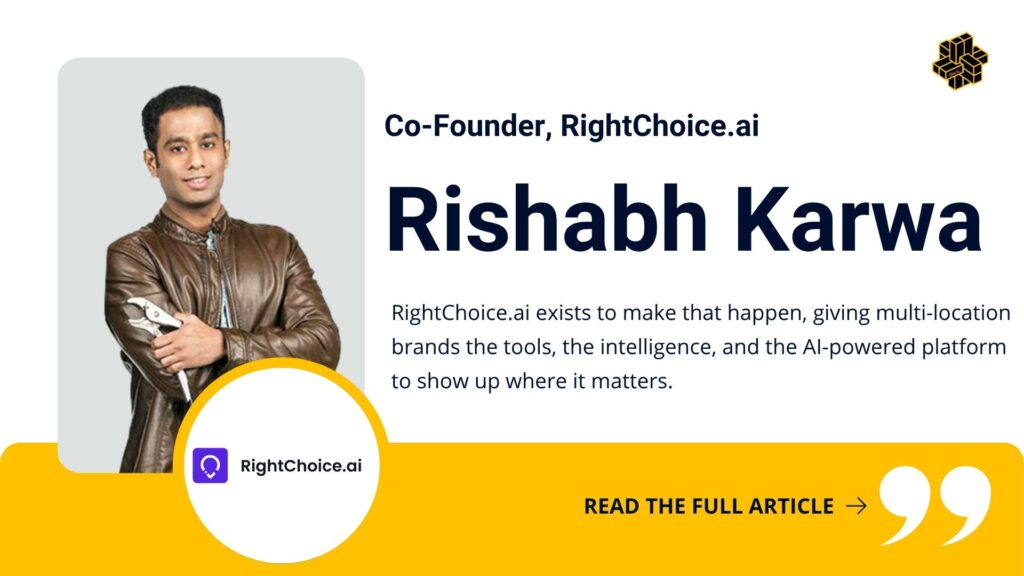
In this MarTech Thought Interview, we sit down with Rishabh Karwa, founder of RightChoice.ai, whose entrepreneurial journey has been built around solving one of the most overlooked gaps in marketing: local visibility at scale. In today’s increasingly fragmented digital landscape, the final moment of customer decision-making is no longer happening on websites, but in local search results, maps, and AI-driven recommendations. After scaling GoMechanic into one of India’s leading multi-location automotive service platforms, Rishabh turned his focus to exactly this challenge. Through RightChoice.ai, he is redefining how enterprises manage their presence where it matters most, at the precise moment customers are ready to act.
About RightChoice.ai
RightChoice.ai is a SaaS platform designed to help multi-location enterprises manage and optimise their local digital presence at scale. By combining listing management, local SEO, review management, and AI-powered insights into a single platform, RightChoice.ai enables brands to improve visibility across maps, search engines, and emerging AI-driven discovery channels. Built specifically for businesses operating across multiple locations, the platform provides real-time tracking, automation, and competitive intelligence to help organisations turn local search performance into measurable customer engagement and revenue growth.
Quick Q&A with Rishabh Karwa
Could you please give us a quick introduction of yourself and your journey leading up to founding RightChoice.ai?
My journey as an entrepreneur started pretty early. I studied at the College of Engineering, Pune, and instead of taking the safe corporate route, I jumped straight into building something from scratch.
We co-founded GoMechanic in 2016 with the idea of organising India’s fractured car servicing & spares industry. The Indian car servicing market, estimated at $8-10 billion at that time, was highly unorganised. We expanded to 75+ cities and partnered with over 1,500 garages, scaling it into one of India’s most recognisable multi-location brands over seven years.
That experience taught me something most people only understand superficially: running a multi-location business is not just about growth; it’s about maintaining control over visibility, consistency, and customer experience at scale. This is precisely where the problems begin.
That gap brought RightChoice.ai to life. I co-founded it alongside Marouf Shaikh in mid-2023, with a clear mission to help multi-location enterprises become visible where decisions actually happen, using solutions such as listing management, Local SEO, and Review Management, with AI automation. RightChoice.ai is today rated a global leader in SaaS on G2; we’ve grown 6X since launch, and the enterprises we work with across healthcare, retail, QSR, and automotive are seeing local search turn into actual, measurable revenue.
What was the initial problem or gap in the market that inspired you to build RightChoice.ai?
The gap was something that looked simple on the surface but ran very deep in practice.
Brands with multiple locations were pouring serious money into digital marketing, paid ads, national campaigns, social media, and traditional marketing that works. But at the very last moment of the customer journey, when someone nearby was already searching and ready to act, these brands were failing them. Wrong phone numbers. Missing categories. Outdated business hours. Duplicate listings that confused both customers and search platforms. Small problems individually, but devastating at scale.
What worsened it was that nobody was measuring any of it properly. There was no reliable way for a marketing leader to ask, “Across all our locations, where do we currently rank for customers searching nearby?” Traditional SEO tools were built for national or global rankings. They were never intended to operate at the hyperlocal, street-by-street level that multi-location businesses rely on.
So brands were essentially investing in digital marketing while being blind to what was happening at the most important moment, “local search”. That gap between what enterprises needed and what existing tools offered is precisely what RightChoice.ai was built to fill. We brought together local SEO, listing management, competitor intelligence, and AI automation into one platform built specifically for businesses managing tens, hundreds, or even thousands of locations.
Compared to broader digital strategies, local marketing often receives less attention. Why do you believe it has become increasingly critical for enterprise growth today?
The decision-making moment has fundamentally shifted, but most brands have not fully caught up with where that customer moment now occurs.
Think about how people actually discover a business today. They don’t start by visiting your website. They open Google Maps, type “Near me” into the search bar, or ask an AI for a recommendation. By the time they’re doing that, they’re not casually browsing. They’ve already decided what they want. They just need to decide who to go to. That 10-second window, visible on a map, in a listing, or in an AI-generated answer, is the moment that matters most.
And here’s what makes it even more critical. A growing number of customers never click through to a website at all; they read reviews, check photos, look at hours, and make their decision right there. A listing is the first impression a brand makes when a customer is searching. It works exactly like a website, except the customer never leaves the page. For any brand running multiple locations, this makes local visibility a direct driver of store-level revenue, not a side task, not a support function, but a primary growth channel.
And unless you are actively tracking visibility through tools like hyperlocal ranking grids and AI visibility tracking, you’re essentially blind at the most important moment of the funnel.
Platforms like Google, Apple Maps, Bing, and Waze are becoming key discovery channels. How should brands rethink their presence on these platforms?
The most important mindset shift is to stop thinking of a listing as something you set up once and leave alone.
A listing today is a live conversion channel. It carries your reviews, your photos, your services, your offers, your hours, your Q&A, and every single element of it influences whether Google recommends your business or your competitor’s. If you don’t actively manage and regularly update it, it quietly falls behind. Customers notice. Algorithms notice. And over time, rankings slip, and customer leads drop, often without the brand even realising why.
The second thing brands need to get right is scale. Managing 5 listings is easy. Managing 500 requires systems, centralised control, automation, and real-time monitoring. This is where solutions like bulk listing management, review management, and profile tracking with competitors become essential.
And then there’s measurement, which is where most enterprises are genuinely behind. Clicks and impressions tell you something, but they don’t tell you enough. The real questions are which of your locations are gaining or losing ground in local searches? How do you rank against competitors within a 3 to 5 km radius of each store? How does your local ranking directly connect to store visits and revenue? Until you can answer those questions with confidence, you’re making decisions based on guesswork. And in a competitive local search environment, guesswork is expensive; the best bet is making decisions based on the performance of your KPIs.
What are some common mistakes brands make when it comes to managing their local digital presence?
After working with hundreds of multi-location brands across different markets and industries, the same mistakes come up time and again.
The first is data inconsistency across platforms. A mismatch between listings, missing categories, invalid phone numbers, and duplicate profiles – it all impacts trust and business ranking. This is precisely when centralised listing management and directory synchronisation systems become essential.
The second mistake is treating local visibility as a one-time project. Brands do a big listing hygiene cleanup; it looks outstanding, and the team moves on. But local search is dynamic: competitors update, directories evolve, some listings have errors, and visibility shifts constantly. Without continuous monitoring and automated alerts, performance drops quietly.
The third is measuring against the wrong competition. Most enterprises benchmark themselves against other national brands. But local search doesn’t work that way. The real competitor is often within a few kilometres; it is not a national brand. This is where competitor heatmaps and local share-of-voice tracking become critical.
The fourth, and probably the most costly, is having no measurement framework at all. Most brands we speak to cannot tell you their share of local search voice, how their rankings have trended over time, or which specific locations are underperforming. Without that data, you cannot make smart decisions. You cannot prioritise. You cannot improve. Solving this visibility gap for enterprises is one of the core things we built RightChoice.ai to do.
How do you see AI and automation transforming local marketing and location-based engagement in the coming years?
We are right in the middle of one of the biggest shifts in how people discover businesses, and I genuinely think most marketing teams haven’t fully grasped what it means yet.
For years, local search meant typing a query into Google and scrolling through results. This behaviour is rapidly changing. More and more, people are asking AI assistants, ChatGPT, Gemini, and Google AI to simply tell them the best option nearby.
And when that happens, there is no ranked list of links. There is a direct recommendation, generated from signals the AI has decided to make one business more trustworthy, more relevant, and more credible than another. Review quality, listing consistency, content depth, and response patterns; these all feed into that recommendation.
This is what we call AI visibility, and it is the next major frontier in local marketing.
At RightChoice.ai, we’re already enabling this process through tools like AI Ranker (prompt-level tracking), AI Citations tracking, and AI sentiment analytics, helping brands understand how they appear across AI platforms. Supported by a fully AI-automated dashboard that continuously analyses visibility, rankings, and competitive signals across locations in real time.
As a founder, what has been one key lesson from building and scaling RightChoice.ai across multiple markets?
Through trial and error, I’ve learned that what works in one market may not work in another. Local nuance is not a small detail. It shapes everything.
When we started expanding from India into Southeast Asia and the Middle East, the instinct was to take our proven approach and replicate it. Same platform, same strategy, same playbook. What we quickly discovered is that every market has its own character, and that character matters enormously in local search.
Which platforms dominate varies by region. In some markets, Google Maps is the clear primary channel. In others, Apple Maps carries far more weight, especially among urban consumers. Search behaviour is different.
What this experience taught us is that you can and should standardise your infrastructure and operations; you cannot standardise your strategy. Some of our strongest product features, from Geo-grid ranking insights to local competitor intelligence, have come directly from these learnings.
Looking ahead, what excites you most about the future of local marketing and its role within the broader MarTech ecosystem?
The brands that will win in the next five years are not necessarily the ones with the biggest marketing budgets; they are the ones that understand where their customers are making decisions and show up there consistently. Local marketing is rapidly becoming that place. AI assistants are already changing how people discover businesses nearby, and the brands appearing in those recommendations have earned it through consistent data, trusted reviews, and a well-managed local presence across every location they operate. That shift is already happening, and the window to get ahead of it is right now.
As AI becomes the default way people discover local businesses, local marketing stops being just a channel and starts being the core strategy. The brands investing in their listing quality, their reviews, and their location-level data today are building something that will only grow more valuable over time. RightChoice.ai exists to make that happen, giving multi-location brands the tools, the intelligence, and the AI-powered platform to show up where it matters, across every location and every market they operate in.
What excites me most, though, is the day, and it is not far off, when a brand can sit down and say with complete confidence, “This local search ranking directly drove this many store visits?” and this much revenue this month. No more guesswork. Real, attributable, undeniable business impact. That is what we are building toward at RightChoice.ai. Because the way I see it, your customers are already out there, searching for exactly what you offer, ready to walk through your door. The only question is whether they find you or someone else, and that is a question no brand should leave to chance.
Rishabh’s perspective highlights a powerful shift in modern marketing. As AI reshapes how customers discover businesses, local visibility is no longer a supporting tactic but a core growth driver. The brands that succeed will be those that treat local presence as a measurable, strategic function rather than an afterthought. With the rise of AI-driven discovery and hyperlocal decision-making, the future belongs to organisations that can connect visibility directly to real business outcomes, turning search into revenue with clarity and confidence.
Join Us Now!
Ready to elevate your marketing strategy? Be part of our Upcoming Events – where innovation, networking, and cutting-edge insights meet in vibrant cities around the world. We can’t wait to welcome you in person!
Can’t attend in person? No problem. Join BEETc On-Screen, our On-Demand Learning Platform, for exclusive access to 500+ sessions and over 300 hours of content from global summits. Upskill at your own pace, gain actionable insights, and stay ahead in a rapidly evolving business landscape.
Stay up to date with our Speaker Line-up, Session Information, and Agenda Updates by following us on:
See more MarTech Thoughts interview pieces here!
Last updated: May 2026