
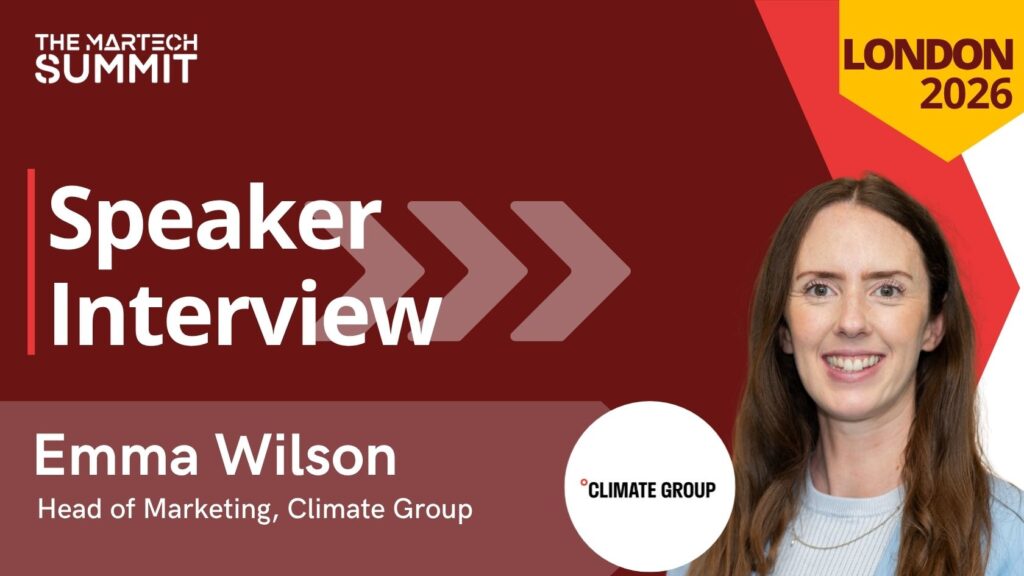
Ahead of The MarTech Summit London 2026, we spoke with Emma Wilson, Head of Marketing at Climate Group, about what it takes to build trusted, credible marketing that reaches senior decision-makers and turns attention into meaningful action. Emma shares a valuable third-sector perspective on MarTech, exploring how data and AI can help marketers understand stakeholder journeys, demonstrate influence beyond traditional metrics and balance immediate performance with impact that may take years to materialise.
About Climate Group
Climate Group is an international non-profit organisation working with businesses and governments to accelerate the transition towards a cleaner and more secure future. It brings together more than 800 businesses and governments through programmes focused on areas including energy, transport and industry, and is also behind Climate Week NYC, one of the world’s largest annual climate events.
Quick Q&A with Emma Wilson
Could you please give us a quick introduction of yourself and share a bit about your role at Climate Group?
I’m Emma Wilson, Head of Marketing at Climate Group, an international non profit working with businesses and governments to accelerate the shift to a cleaner and more secure future. I’m also a Chartered Marketer with the Chartered Institute of Marketing (CIM), and a proud Bloom UK member and mentor.
I lead our global marketing strategy, spanning brand, integrated campaigns, digital and MarTech. A key part of my role is building influence with senior stakeholders, from C-suite business leaders to partners, and turning that influence into progress.
As AI reshapes how information is discovered and consumed, the role of marketing is changing incredibly quickly.
Why did you choose to participate in this summit?
I’m especially excited to see greater representation from the third sector at The MarTech Summit.
Charities in England and Wales generate almost £107 billion in annual income, with more than 170,000 on the register, yet the sector’s marketing innovation is often overlooked.
We compete for attention alongside some of the world’s biggest brands, often with a fraction of the budget. That makes integrated MarTech essential, from making every pound work harder to understanding our audiences and creating more connected experiences.
I’m looking forward to sharing that perspective and exploring what commercial and third-sector marketers can learn from each other.
You work closely with businesses, governments and C-suite leaders. What have you learned about creating marketing that genuinely captures the attention of senior decision-makers?
One of the best recent reminders I’ve had came from John Marshall at Potential Energy Coalition: whether you’re marketing B2B, B2G or B2C, ultimately you’re still marketing to a human being. Senior leaders have different pressures and priorities, but relevance, trust and credibility still determine whether they pay attention.
MarTech helps us deliver that at scale: using data and AI to understand stakeholder priorities, personalise journeys across channels and measure what happens beyond the click. The challenge is connecting engagement to tangible outcomes – whether that’s a new partnership, investment or policy commitment – to understand the real-world influence of our marketing.
Can you share a campaign or initiative where marketing helped move an audience from awareness to meaningful action? What made it work?
Membership marketing is a great example. Climate Group brings together more than 800 businesses and governments through programmes spanning energy, transport and industry. Our theory of change starts with organisations making ambitious commitments, then working collectively to help shift whole systems.
But organisations don’t make decisions; people do. Marketing needs to give an internal champion the evidence and value proposition to make the case. MarTech helps us understand where they are in that journey, but the meaningful action isn’t a click or form fill; it’s someone convincing their organisation to commit to change.
You’ve built teams and partnerships around long-term impact. How do you balance the pressure for immediate marketing results with objectives that may take years to fully realise?
I lead marketing for Climate Week NYC, the world’s largest climate event. We have seven days to capture attention, but the impact can take years to materialise.
MarTech helps us measure both: optimising registrations, engagement and audience quality in real time, while creating a data trail that helps us understand influence over time. Our case studies make that value tangible, from L’Oréal launching a €15 million Climate Emergency Fund to California announcing its landmark climate accountability lawsuit on our stage. Ultimately, we need to measure not just who we reached, but what happened next.
Can you share one personal or professional goal you’d like to achieve in 2026?
One of my goals for 2026 is to be more intentional about building my own profile. I’ve spent years building brands and giving other people a platform, while often being much less comfortable promoting myself. So, in 2026 I’ve been deliberately saying yes to speaking opportunities and sharing my expertise. Social mobility is also very important to me through The 93% Club. I’ve sometimes questioned whether I’m meant to be in certain rooms; becoming more visible is partly about challenging that instinct and, hopefully, helping others do the same.
Emma’s perspective offers an important reminder that behind every B2B, B2G or B2C audience is ultimately a person making a decision. Technology can help marketers understand their priorities, personalise their journey and measure engagement, but relevance, trust and credibility remain fundamental to earning attention and influencing action.
Join Emma and fellow marketing leaders at The MarTech Summit London 2026 on 10–11 November at Convene 155 Bishopsgate, where senior practitioners will come together to explore AI, data, customer experience, marketing technology and the changing role of modern marketing.
The MarTech Summit London – Smarter Stacks. Stronger Growth.
The MarTech Summit London returns this November as Europe’s flagship MarTech event, bringing together over 600 senior marketing, customer experience, digital, data and technology leaders for two days of practical learning, meaningful networking and forward-looking discussions on the future of marketing technology.
Designed for practitioners rather than product pitches, this year’s summit features more than 90 speakers, 30+ leading solution providers, and over 33 sessions across three stages, covering everything from AI-powered marketing and customer intelligence to first-party data, marketing operations, customer experience and revenue growth.
Whether you’re modernising your MarTech stack, scaling AI adoption or improving marketing performance, The MarTech Summit London is designed to provide practical ideas you can take back to your organisation.
Hosted once again at Convene 155 Bishopsgate, this closed-door summit creates an environment where senior decision-makers can openly discuss challenges, exchange ideas, and learn from one another.
➡ Interested in becoming a partner? Don’t hesitate to get in touch with us at sponsor@themartechsummit.com.
Can’t attend in person? No problem. Join BEETc On-Screen, our On-Demand Learning Platform, for exclusive access to 500+ sessions and over 300 hours of content from global summits. Upskill at your own pace, gain actionable insights, and stay ahead in a rapidly evolving business landscape.
Stay up to date with our Speaker Line-up, Session Information, and Agenda Updates by following us on:
See more MarTech Thoughts interview pieces here!
Last updated: August 2026