
Beyond SEO: Engineering an AEO Engine to Capture AI-Driven Search & Conversions
TL;DR — Answer Engine Optimisation (AEO) is the discipline of earning citations inside AI-generated answers — ChatGPT, Perplexity, Google’s AI Overviews — rather than only ranking beneath them. It doesn’t replace SEO; it sits on top of it. But treating AEO as a checklist of tactics fails, because AI-driven search rewires discovery, trust, and conversion at the same time. What works is an engine: one system where SEO, AEO, extractability, and conversion are designed into every page from the first block — and measured honestly, because AI answers are probabilistic, not rankable.
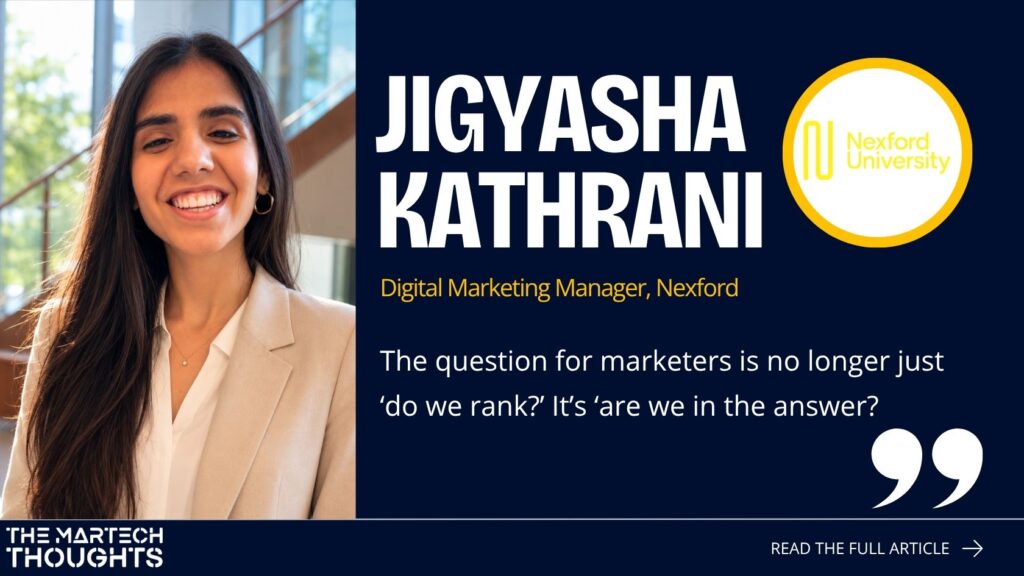
Somewhere in the last two years, a quiet thing happened to the customer journey: it started before the click. Your prospective customer asked an AI assistant “what’s the best option for X?” — and by the time they arrived on anyone’s website (if they arrived at all), they’d already been given a shortlist, a comparison, and a recommendation. The question for marketers is no longer just “do we rank?” It’s “are we in the answer?”
I’ve spent my career in the machinery of marketing — automation, paid media, the connective tissue between channels — and I’ve watched plenty of “next big things” arrive with a checklist attached. This one is different. AI-driven search doesn’t add a channel to your stack; it changes what discovery, trust, and conversion mean at the same time. That’s why I stopped thinking about it as a tactic and started engineering it as an engine.
About the author
Jigyasha Kathrani builds marketing systems that are measurable and memorable. Her name comes from the Sanskrit word for curiosity — jigyasa — and she has spent her career living up to it: pulling apart the machinery of marketing automation, paid media, and multi-channel journeys to understand not just what each tool does, but why it matters and who it serves. She currently works as a Digital Marketing Manager at Nexford, a next-generation online university transforming access to affordable, career-focused education worldwide. In her career, she has led multi-channel campaigns across strategic global markets, blending strategy with performance data to tell stories that create value in the in-between stages of the customer journey. One of her current obsessions is the biggest rewiring of discovery since the search engine itself: how AI answers are reshaping the way customers find, trust, and choose brands — and what marketers must engineer in response.
What is AEO — and is SEO dead?
Let’s answer the question every marketing leader has typed into Google (and, tellingly, into ChatGPT).
Answer Engine Optimisation (AEO) is the practice of structuring your content, evidence, and authority so that AI answer engines cite your brand when users ask questions in your category. Where SEO competes for a position on a results page, AEO competes for a place inside the answer itself — a citation, a mention, a recommendation.
And no, SEO is not dead. This matters, because “beyond SEO” is often misread as “instead of SEO”. The AI systems generating answers lean heavily on the same signals traditional search rewards: crawlable sites, authoritative content, clean structure. Bing’s index feeds ChatGPT’s search and Copilot. Google’s AI Overviews are built on Google’s index. Kill your SEO and you starve your AEO. The relationship is a stack, not a succession:
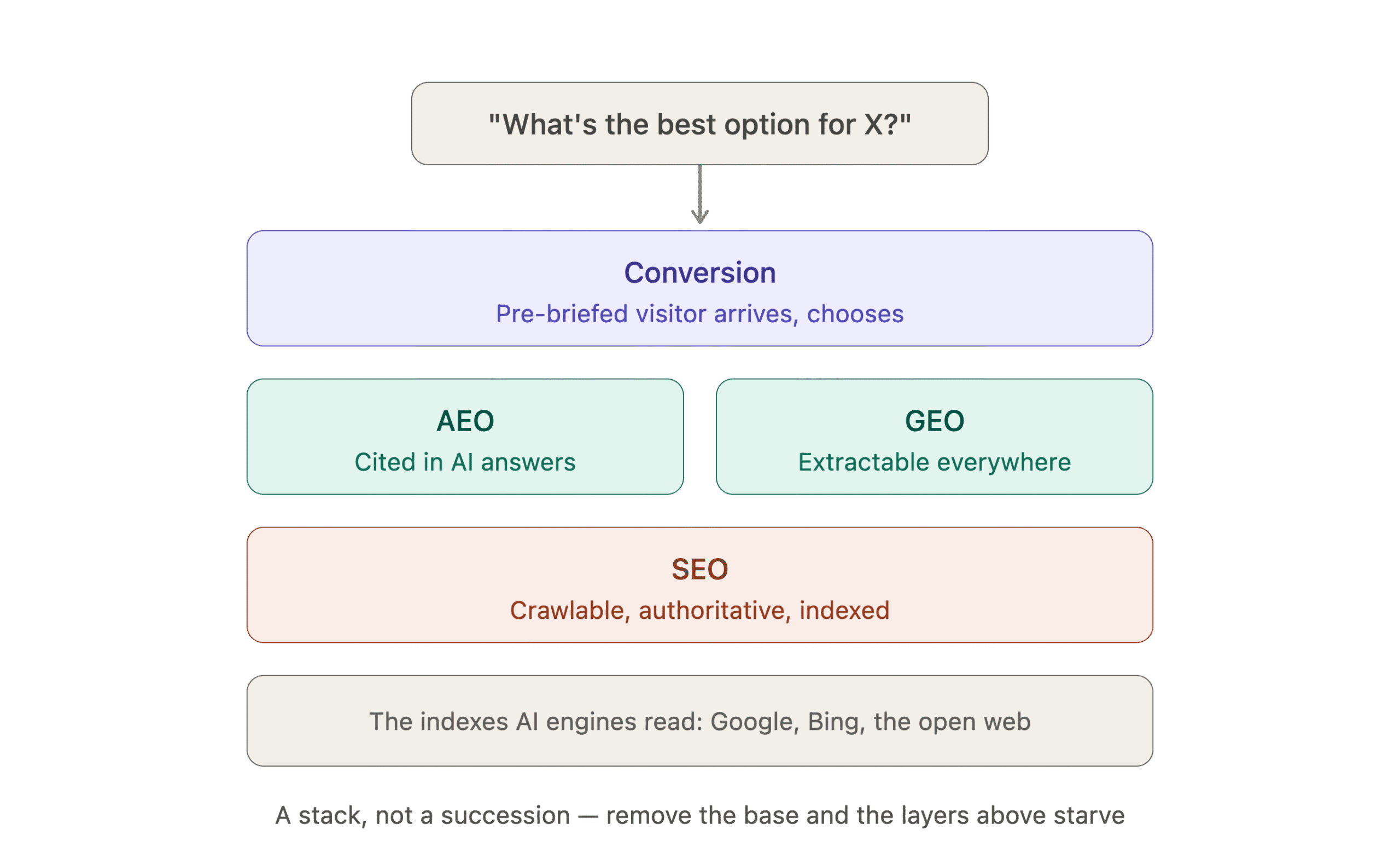
There’s a third layer worth naming, because it gets different treatment even though it shares techniques with AEO: Generative Engine Optimisation (GEO) — structuring content so that any generative surface (AI Overviews, AI Mode, voice assistants, in-app AI features) can extract it verbatim or near-verbatim. AEO is about being credited; GEO is about being extractable. A page engineered for both looks different from a page engineered for either.
Why a checklist of AEO tactics fails
Here’s the trap I see intelligent teams walking into: they treat AEO as a bolt-on. Add an FAQ block. Sprinkle some schema. Publish a “best X” listicle. Job done.
It fails for three reasons.
First, the disciplines conflict unless they’re designed together. The classic conversion playbook says put the lead-capture form high and lead with persuasion. The citation playbook says lead with a direct, quantified, extractable answer. Do both naively and you get a page where the form buries the very content an AI would cite — or a beautifully citable page that converts nobody. These trade-offs can’t be resolved at the end of production. They have to be resolved at the block level, before a word of copy is written.
Second, AI answers are probabilistic. Ask the same question of the same model five times and you may get different brands cited. There is no “position 3” to screenshot for the board. If your measurement approach is built for rankings, you will either fool yourself with a lucky single sample or conclude nothing is working when it is. Citation presence is a frequency across sampled runs — never a binary from one query.
Third, trust is now built off-site as much as on it. Answer engines synthesise from the open web: your pages, yes, but also comparison sites, community threads, reviews, and third-party mentions. A brand that only optimises its own domain is optimising a fraction of the surface the AI actually reads. Reputation across the ecosystem is the ranking factor.
A checklist can’t hold all of that. An engine can.
Anatomy of an AEO Engine
An engine, in my definition, is a repeatable system where every page is designed to satisfy multiple disciplines simultaneously, every claim is verifiable, and every result is measurable against a baseline. Mine runs on five interlocking parts:
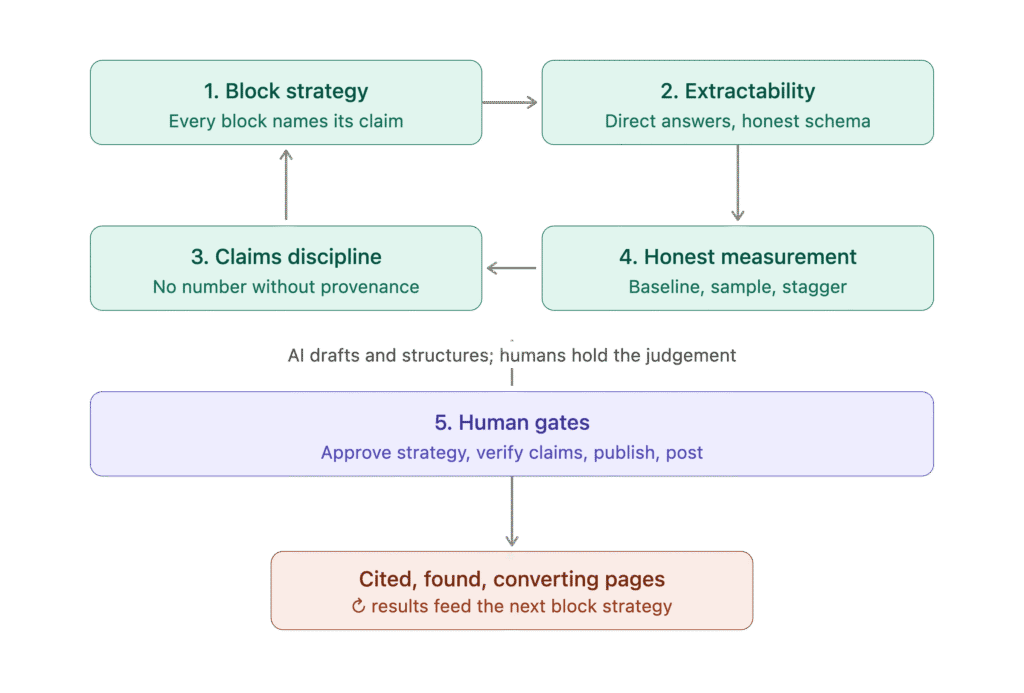
1. Block strategy before copy. Every page starts as a table of blocks, and every block declares which discipline it serves and — critically — what its extractable claim is: the specific, quantified, attributable sentence an AI could lift and cite. If a block can’t name its claim, it doesn’t earn its place. Strategy gets approved before production begins, so conversion elements and citation elements are positioned deliberately rather than fighting for space later.
2. Extractability engineering. Answer engines favour content that is easy to lift: a direct answer in the first 50 words, dense comparison tables where every row stands alone as a fact, FAQ sections phrased the way humans actually ask. Structured data helps machines parse — but only when it mirrors the visible page exactly. (And a note of honesty the industry skips: FAQ schema hasn’t produced rich results for most commercial sites since 2023. Deploy it as machine-readability hygiene; never sell it as a magic lever.)
3. Claims discipline. This is the part nobody finds glamorous and everybody needs. Every statistic, outcome, and named third party on a page traces to a verifiable source, logged with a date. Not just for compliance — for citation durability. AI systems increasingly cross-reference; content built on unverifiable claims is content built to be dropped from answers. My personal rule, and this article follows it: no number without provenance. You’ll notice this piece quotes almost no statistics. That’s deliberate. The AEO space is currently awash with figures nobody can trace, and repeating them is how misinformation launders itself into strategy decks.
4. Honest measurement. Baseline before you act: sample your target prompts across surfaces (ChatGPT, Perplexity, Copilot, Gemini, AI Overviews), multiple runs each, logged with dates and model versions, before the new page ships. Then stagger: let the page index before distribution begins, or you’ll never know which intervention moved the needle. Watch what’s actually observable — AI-assistant referrals are visible in your analytics as a small but real segment; AI Overview traffic, by contrast, is not separable from ordinary organic traffic, so anyone quoting you a precise “AIO traffic number” is estimating, not measuring. Use citation frequency and branded-search trend as your proxies, and say so.
5. Human gates. AI does what it does best — synthesis, structure, drafting, pattern-finding at scale. Humans hold the four moments that carry risk and judgement: approving the strategy, verifying the claims, pressing publish, and posting in communities. Community trust, in particular, is earned by people. An engine that automates the posting automates the destruction of the very credibility it’s trying to build.
What changes for conversion when the answer arrives first
Here’s the part most AEO commentary misses entirely: the visitor who arrives from an AI answer is not the visitor who arrived from a blue link.
They’ve been pre-briefed. The AI has already compared you to alternatives, summarised your positioning, and — if you’ve done the work — cited your evidence. They land further down the funnel, with sharper questions and less patience for being marketed at.
That changes conversion architecture:
- Scent continuity now runs from the prompt, not the ad. The page’s opening must mirror the intent of the question that brought them — within the first few words — or the journey breaks at the threshold.
- Reference content converts on click-through, not capture. For discovery- and research-stage pages, the highest-performing move is often removing the form and routing intent cleanly to the decision page. Gate the reference content and you suppress both the citation and the conversion.
- The page must survive being quoted out of context. Any block might be the only part of your site a prospect ever sees, paraphrased inside an answer. Every block, therefore, has to carry your positioning on its own.
Conversion optimisation and answer optimisation stop being separate meetings. They become one design conversation, held early.
Where to start: a 90-day sketch
If you’re a marketing leader looking at this and wondering where to begin, resist the audit-everything instinct. Start narrow and falsifiable:
Weeks 1–2 — See what the machines see. Confirm AI crawlers can actually reach your site (security plugins and bot rules silently block them more often than anyone admits). Then sample five to eight prompts your customers genuinely ask, across the major surfaces, several runs each. Log who gets cited. That log is your baseline — and usually your wake-up call.
Weeks 3–6 — One page, engineered properly. Pick a question you have genuine authority to answer, in a lane no competitor owns outright. Build it block-by-block: extractable claims, verified evidence, conversion elements placed after the citable content, schema mirroring the visible page.
Weeks 7–12 — Publish, stagger, measure. Ship it, let it index, then distribute. Re-sample your prompts on a fixed cadence. Expect an early read, not a verdict — probabilistic systems need time and repeated measurement before they’ll tell you the truth.
One page, engineered end-to-end, will teach you more than a fifty-page audit — because it forces every discipline to negotiate with the others on real ground.
Final thought
The brands that win AI-driven search won’t be the ones that discovered a clever schema trick. They’ll be the ones that built the operating discipline: verifiable claims, extractable structure, honest measurement, and the humility to let humans hold the moments that matter. The answer engines are, in a sense, the most demanding audience marketing has ever had — they cross-reference, they don’t click on charm, and they quote you out of context. Engineering for them makes your marketing better for humans too.
That’s the real story of AEO: not a new channel to conquer, but a forcing function for the rigour we should have had all along.
Frequently asked questions
What is Answer Engine Optimisation (AEO)? AEO is the practice of structuring content, evidence, and authority so AI answer engines — ChatGPT, Perplexity, Copilot, Google’s AI Overviews — cite your brand inside their answers, rather than only ranking your pages beneath them.
Does AEO replace SEO? No. AEO builds on SEO. AI answer engines draw on traditional search indexes and reward the same fundamentals: crawlable sites, authoritative content, clean structure. Weak SEO starves AEO of raw material.
What is the difference between AEO and GEO? AEO targets citation — being credited in AI answers. GEO (Generative Engine Optimisation) targets extractability — structuring content so any generative surface can lift it verbatim. They share techniques but shape pages differently.
How do I measure AI search visibility? Sample your target prompts across AI surfaces multiple times on a fixed cadence, and track citation frequency — never a single query result. Supplement with AI-assistant referral traffic in analytics and branded-search trends as proxies.
How do I get my brand cited by ChatGPT and AI Overviews? Ensure AI crawlers can access your site, answer real customer questions directly within the opening lines, back every claim with verifiable sources, use structured data that mirrors visible content, and build third-party reputation — answer engines read the whole ecosystem, not just your domain.
Continue the Conversation at The MarTech Summit
As AI continues to reshape how customers discover, evaluate and choose brands, conversations like this are becoming an increasingly important part of modern MarTech strategy. At The MarTech Summit, our goal is to keep those conversations moving – bringing together marketers, technologists and industry leaders to exchange practical experiences, challenge established thinking and learn from one another. Join The MarTech Summit community for more insights from practitioners shaping the future of marketing technology, and continue the conversation face-to-face at our physical summits around the world.
Join us at our upcoming events across Stockholm, Amsterdam, Manila, Hong Kong, Bangkok, Singapore, London, Berlin, Jakarta, Paris, and Madrid, where industry leaders will share practical insights, real-world case studies, and future-facing strategies on AI, customer experience, data-driven marketing, brand loyalty, and MarTech transformation.
Whether you are looking to sharpen your marketing strategy, discover new technologies, or connect with peers facing similar challenges, The MarTech Summit offers a space for thoughtful conversations, meaningful networking, and actionable ideas that can help shape the next era of marketing.
Explore our upcoming events and be part of the global MarTech conversation.
➡ Interested in becoming a partner? Don’t hesitate to get in touch with us at sponsor@themartechsummit.com.
See more MarTech Thoughts interview pieces here!
Stay up to date with our In Person Summit, Session Information, and Agenda Updates by following us on:
Last updated: August 2026