
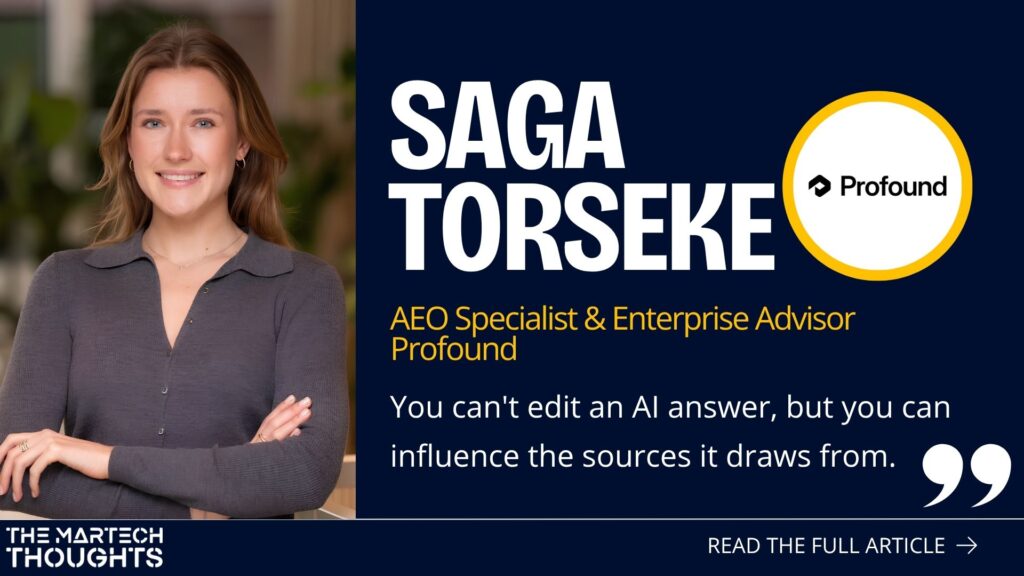
As AI search becomes an increasingly important part of how people discover and evaluate brands, simply appearing in an AI-generated answer is no longer enough. AEO is evolving from visibility to influence, with marketers needing to control how AI describes their brand, what sources shape those answers, and whether the resulting sentiment, positioning and recommendations reflect what the brand wants to communicate. Ahead of The MarTech Summit London, we spoke with Saga Torseke, AEO Specialist & Enterprise Advisor at Profound, about this next evolution of AEO and how Profound helps brands turn AI visibility insights into practical actions that can shape how AI talks about them.
Profound: Control How AI Sees Your Brand
Profound is an AI visibility and optimisation platform that helps brands understand how they appear across AI-powered search and answer engines. The platform provides insights into how AI systems represent brands, products and competitors, including visibility, citations, sentiment and accuracy. It also helps marketing teams identify opportunities to improve their presence and influence how AI-powered platforms discover and represent their brand.
Quick Q&A with Saga Torseke
Tell us about yourself and how you got involved in AEO.
I’m Saga Torseke, and I work in the enterprise go-to-market team at Profound, helping enterprise companies understand how AI assistants and AI search engines like ChatGPT, Gemini and Perplexity talk about their brands. I got into AEO because people were clearly starting to ask AI instead of searching, and brands had almost no view into the answers they were getting. I saw the opportunity, and I wanted to join the category leader in the space. Today I work with marketing teams to turn what the data shows into practical next steps. It’s a fast-moving field, and I’m still learning something new every week.
What does AEO mean today, and what misconceptions do you still hear?
AEO, or Answer Engine Optimisation, is the work of understanding and improving how your brand appears when AI answers questions about your category, products and competitors. It builds on SEO and does not replace it. One of the biggest misconceptions is that to increase visibility, we need to focus on optimising our owned website content. That’s one thread, but the citation data clearly shows that third-party sources are increasingly important. That creates an earned and paid media strategy. It creates a social strategy. Accuracy and sentiment create a communications strategy. This is not just a content challenge. It’s a challenge that spans the whole marketing function and beyond.
Beyond visibility, what should marketers look at to know whether AI represents their brand the way they want?
Visibility tells you whether you show up. It does not tell you what AI says once you do. Marketers should look at sentiment, meaning whether the framing is positive, neutral or negative. They should look at accuracy, such as whether pricing, features and positioning are current and correct. And they should look at how AI places them against competitors, including who gets recommended for which use case. Citations matter too, because they show which sources are shaping the answer. A brand can be mentioned in every response and still be described as the expensive option or the outdated one. That is a very different outcome from being recommended for the right reasons.
If AI describes a brand inaccurately or poorly, how much influence does the brand have?
More than most teams expect, though you don’t always have direct control. You can’t edit an AI answer, but you can influence the sources it draws from. Models build answers from what they find: your own site, review sites, press, community discussions and third-party comparisons. If the outdated claim comes from an old page, you can fix it. If a competitor’s comparison page is shaping the story, you can publish clearer, better evidence of your own. The first step is finding which sources the AI is citing for the inaccurate claim. Making these changes can have a fairly fast impact on the narrative.
What practical actions should teams take to increase their visibility?
One of the most important things I want to share is the need to take action on the insights you receive. The customers we work with are using Profound agents to scale the work across the entire marketing function, for example:
- Creating content and web pages
- Optimising PDP pages at scale for AI visibility
- Building strategy to influence third parties
- Monitoring accuracy and sentiment
- Flagging where they need to influence and make change
Many customers are even using the AI insight data to inform product strategy. The best teams are building a library of agents to do the work for them, and teaching those agents the context of their company, so the accuracy and quality of their suggestions keep getting better.
How do SEO and AEO work together? Should companies build a separate AEO team?
In many companies, SEO and AEO are managed within the same team. Crawlable pages, clear structure, authoritative content and strong technical foundations all still matter, because AI engines rely on the same web. What changes is the question you’re answering. SEO asks where you rank. AEO asks what AI says about you and whether it recommends you. For many businesses, AEO is delivered by the performance marketing teams that manage SEO.
In other organisations, including many enterprises, the CMO is driving strategic transformation with AI visibility and insights at the heart of it. The AI insights in microcosm represent how consumers are engaging with your brand, and the entire marketing function can work off of this data. Combine that with a platform such as Profound that allows you to automate and scale your work, and it quickly becomes a strategic lever.
Looking ahead to 2027, which AEO trends should marketers prepare for?
Personal Agents like Muse and Instinct will only increase reliance on AI. As personal agents help people research, compare and buy, product data and merchant information will matter far more.
Saga’s insights highlight that AEO is becoming a broader marketing challenge, extending beyond website content and into earned media, social, communications, data and brand reputation. As AI increasingly influences how customers discover and evaluate businesses, marketers will need to understand not only whether their brand appears, but also how it is described, positioned and recommended.
Continue the Conversation at The MarTech Summit London
Join Saga Torseke at The MarTech Summit London for her keynote, [AEO & AI] The Next Evolution of AEO: Shaping How AI Talks About Your Brand, where she will explore how marketers can turn AI visibility insights into practical action.
See more MarTech Thoughts interview pieces here!
Stay up to date with our In Person Summit, Session Information, and Agenda Updates by following us on:
➡ Interested in becoming a partner? Don’t hesitate to get in touch with us at sponsor@themartechsummit.com.
Last updated: October 2026