
How can businesses achieve sustainable growth when marketing budgets are constantly under pressure? The answer isn’t always about spending less, but about making smarter decisions at the intersection of business strategy and marketing execution.
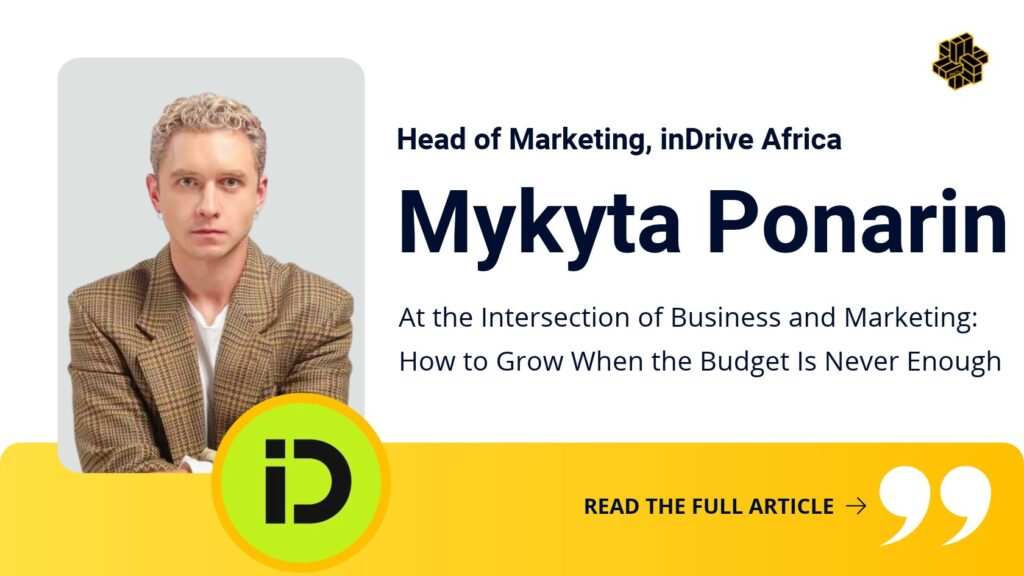
In this edition of MarTech Thoughts, Mykyta Ponarin, Head of Marketing at inDrive Africa, shares his firsthand experience of navigating budget constraints across diverse markets. Drawing on real-world examples from Brazil, Nigeria, South Africa and the Democratic Republic of Congo, he explores how strategic partnerships, localisation, creative approaches and data-driven decision-making can improve marketing efficiency.
From rethinking performance metrics to prioritising relevance over reach, Mykyta offers a practical perspective on why effective marketing starts with the right business decisions, not simply a bigger budget.
At the Intersection of Business and Marketing: How to Grow When the Budget Is Never Enough
Marketing efficiency is rarely created by marketing alone. Under constraint, the strongest decisions happen where business strategy and marketing execution reinforce each other.
Marketing entered my professional life via performance campaigns. Each euro has its unique report, revealing its true essence. Working in performance teaches humility, since within only several days, you understand whether the efforts bear fruit or merely create impressions. Above all else, however, one learns one fundamental principle – money never suffices. Not due to financial scarcity, but rather due to the disparity between desires and media planning.
Every report is built on top of a measurement stack, and in constrained times, that becomes equally significant as the media planning process. First of all, I stopped trusting any figures shown by platform dashboards. Advertising ecosystems usually like taking full credit for the conversions they bring in, while the traditional last-click model always favours the touchpoint closest to purchase. Our approach consisted of combining insights gained via a range of techniques, among them a mobile measurement partner connecting installations to subsequent events, a four-week period of evaluation when considering a channel’s performance, and incrementality measurement methods that help distinguish demand creation channels from demand capturing ones. With the advent of various privacy policies, most notably Apple’s App Tracking Transparency update, user-level tracking became almost impossible; hence, marketing mix modelling resurfaced as an alternative allowing for assessment of all parts of the marketing budget, including brand efforts without clicks or conversions.
However, apart from tracking outcomes, there is another critical aspect – selecting the metric the algorithms optimize for. Algorithms from companies such as Google and Meta do whatever they can according to your instructions: If you want installs, expect cheap installs but not quality users. By taking that goal a little bit further to acquisition, initial trip completion, reorder, or projected lifetime value, then feeding that objective server-side via conversion APIs, you may unlock the greatest efficiency opportunity. There is no additional cost associated with media here.
Technology is not meant to substitute decision-making when deciding which battles to fight, but it serves as a tool for doing so effectively. Technology helps us identify opportunities for cutting, prove opportunities worth investing more in, and quantify the brand’s contribution to performance efficiency gains.
Three essential principles learned from performance marketing continue to serve me to this day. Firstly, cut out unnecessary elements – audiences who do not bring conversions, distribution methods aimed solely at increasing recognition yet failing to produce real growth, and campaign ideas that survive only through inertia. Secondly, increase investments in whatever works. There is no less expensive option than duplicating the successes achieved. Thirdly, which took me some time to realise, integrate brand-related features into performance activities. A commercial appears significantly cheaper to consumers aware of your existence, and the individual emotionally engaged succeeds, regardless of the accuracy of your product description.
I realised, however, that there were aspects of efficiency improvement that these practices alone did not account for. The best efficiencies achieved never resulted from within the media strategy but from decisions made upstream about where to compete, for whom and with what. One could have the most efficient marketing possible but simply be fighting the wrong war. Or one could be provided with the best business decision-making possible and almost half the job was done.
There are four markets that best explain this situation. I will describe them using general principles of approaches and decision-making and not specific figures, which are confidential information. These four markets are not four separate campaigns but four solutions to the same problem, just with different levers.
Brazil: where a partnership buys reach that media cannot
Brazil is very large, and the inclination in such a market would be to be everywhere. The issue is that by spreading resources out to a lot of cities, we were thin in every city. This was where the first key decision was made by the company: to focus its resources on cities where there was already enough volume in the funnel.
Subsequently, marketing encountered a challenge related to reachability. Creating sufficient media weight using television, digital, and outdoor advertising mediums would prove highly expensive, time-consuming, and, most importantly, irrelevant since the focus would be attracted solely through media exposure. Instead, marketers opted to enter into a partnership with Flamengo. Clubs of this standing do not operate simply as advertising canvases but live up to their status throughout all game days, TV screens, social media channels, and conversations fueled by the club’s loyal fan base, one of the most passionate worldwide.
Comparatively speaking, this partnership helped achieve reachability much faster compared to the construction of similar media weight across multiple channels, while, furthermore, it allowed reaching out to audiences carrying intrinsic values, which could never be acquired via a standard media strategy. We did not take the speed on faith: the partnership was assessed by comparing cities exposed to it with similar control cities, so the gain was measured rather than assumed.
It appears essential to state that partnerships represent another route towards reaching consumers rather than simple expenses without return on investment. Such strategies work successfully only when businesses clearly understand how the resulting audience will benefit their ventures further down the road.
Nigeria: localisation instead of media scale
The first thing about Nigeria is that the media budget was smaller, and competing on the scale with bigger players was obviously not going to work for them. Here, the question became how to perform better when it comes to relevance per impression rather than visibility per se.
Marketing made use of local influence and localised creatives – local language, local humour, things that people could relate to from their daily life experience. Localisation fulfilled the role that was impossible for scale. Simultaneously, the company decided to concentrate on those markets where the customer retention would be higher and complete trips more frequent compared to the cheap installations that would vanish within a month.
Two lessons can be taken away here. First, localization becomes a replacement for broader media coverage once you win your audience’s trust via creative content alone. Second, measurement plays a fundamental role, no less crucial than choosing the channel itself. In fact, campaign optimization focused on completed journeys rather than installs; thus, algorithms competed for customers who were most likely to make another trip in the future, rather than merely installing the app.
South Africa: a strategic direction, paired with creative ingenuity
Marketers within South Africa have scrapped the notion of considering Johannesburg as a homogeneous market entity. Instead of wasting their limited financial capital on trying to cover the entire city, they decided to invest selectively within distinct geographical zones. What they observed, after making this decision, is that investing efforts within dense clusters yields much higher dividends compared to trying to cover every inch of the urban space with minimal impact. In order to identify these zones, they used actual data regarding consumer needs and availability of products, namely heat maps of travel requests.
This allowed peak creativity to be achieved while maintaining relatively low production costs and producing something entirely unique. As media alone is insufficient in achieving reach, the ad needs to step up. Here, geographical clustering came into play and worked to reinforce creativity through sufficient repetition within a defined geography to allow efficacy, while at the same time allowing effective interaction with consumers. Creatives were tested via A/B split tests within these clusters, with the most successful ideas receiving funding.
DRC: when the business writes the story
Out of all the nations mentioned here, there appears to be a very obvious instance of successful marketing in the Democratic Republic of Congo. In fact, the key element was the development of a unique motorbike offer, rather than designing an advertising campaign for the brand. Based on insights derived from analysis of trips made by urban residents, including short journeys and heavy traffic conditions, the marketers found a way to position the motorcycle as an inexpensive alternative to cars.
Marketing, thus, did not play a crucial role in differentiating this offer, as it would traditionally do. Rather, the function of marketing consisted in communicating what already existed to the consumer base. Such cases illustrate one of those situations where marketing specialists tend to overlook when focusing on innovative approaches to creative solutions. Marketers’ activities may involve engagement in discussion related to the positioning of a product.
Changes and Constants
In each case presented, one aspect of marketing strategy underwent a change. The lever used differed from one country to another – partnership in Brazil, localisation in Nigeria, creativity in South Africa, and underlying proposition in the DRC. However, several principles remained constant throughout. In other words, they proved universally relevant:
Strategy: geo first, not channel first. Firstly, any strategy must start with determining where the firm wants to operate. Focusing resources improves efficiencies with every strategic choice moving forward.
Strategy: brand & performance = one budget problem. Branding activities result in a specific context in which performance marketing costs less than expected. Resource misallocation yields poor returns.
Strategy: relevance not scale when necessary. Limited budgets dictate a preference for relevance over pure scale. In essence, culturally relevant messaging consistently beats large, yet irrelevant, media buys.
Borrow reach whenever possible: Collaborations with organisations and institutions people trust and follow yield attention and engagement through means cheaper than media buying alone.
Creative leverage in lieu of media leverage: Creativity and compelling storytelling allow marketers to achieve greater frequencies without increasing costs in terms of advertising spend.
Recognise instances in which marketing narratives emerge organically: Product strategies prove valuable enough in their own right that marketers need only enhance them instead of developing separate branding campaigns.
One Connected System
There is no standard recipe for maximising output while minimising input. While practices successful in Brazil would prove inefficient in Nigeria, South African approaches would not create the narrative in the DRC. Such replication of tactics within different contexts results in efficiencies transforming into inefficiencies.
However, there is one thing that applies: the creation of marketing efficiencies through sustainability can only be achieved through simultaneous consideration of decisions about business operations and marketing activities. In this way, once business leaders determine the company’s strategic positioning by defining target audiences and value propositions, the role of marketers is simply to communicate these decisions effectively. With regard to limited resources, this approach transforms the challenge into a constraint that encourages smarter decisions.
About the Author
Mykyta Ponarin is the Head of Marketing at inDrive Africa, with over seven years of experience in B2B and B2C marketing, specialising in market expansion, customer acquisition and sustainable business growth.
Having worked across the USA, Latin America and Africa, Mykyta brings extensive experience in adapting marketing strategies to different market dynamics, consumer behaviours and business environments. His expertise spans performance marketing, marketing mix optimisation, strategic partnerships, localisation, creative strategy and data-driven decision-making.
Currently based in Lisbon, Mykyta is passionate about bridging business strategy and marketing execution to drive measurable results, particularly in emerging markets.
Connect with Mykyta on LinkedIn.
Key Takeaways: How to Improve Marketing Efficiency
Align marketing with business strategy: Marketing efficiency begins with decisions about which markets to prioritise, which audiences to serve and what value to offer.
Measure meaningful business outcomes: Optimising for customer retention, completed purchases or lifetime value can deliver more useful results than focusing on clicks or app installations alone.
Prioritise relevance over scale: Localised campaigns and culturally relevant messaging can help brands compete effectively even with smaller budgets.
Use partnerships to expand reach: Collaborating with trusted organisations can build audience engagement without relying exclusively on paid media.
Make creativity work harder: Targeted geographical investment, experimentation and strong creative execution can improve campaign efficiency without proportional increases in spending.
Continue the Conversation at The MarTech Summit
At The MarTech Summit, we believe these real-world experiences deserve to be shared. Our global community brings together marketing, technology and business leaders to exchange practical insights, challenge conventional approaches and explore how data, creativity and innovation can drive meaningful business growth.
Join us at our upcoming summits across Stockholm, Amsterdam, Manila, Hong Kong, Bangkok, Singapore, London, Berlin, Paris, Madrid and more locations, where industry leaders will share real-world case studies and actionable strategies covering marketing performance, customer engagement, data-driven decision-making, AI and MarTech transformation.
Whether you’re looking to maximise your marketing ROI, rethink your growth strategy or connect with peers facing similar challenges, The MarTech Summit offers a platform for meaningful conversations, fresh perspectives and ideas you can put into practice.l conversations, meaningful networking, and actionable ideas that can help shape the next era of marketing.
Explore our upcoming events and be part of the global MarTech conversation.
➡ Interested in becoming a partner? Don’t hesitate to get in touch with us at sponsor@themartechsummit.com.
See more MarTech Thoughts interview pieces here!
Stay up to date with our In Person Summit, Session Information, and Agenda Updates by following us on:
Last updated: October 2026