
QR codes have become a familiar feature of product packaging, offering brands new ways to connect physical products with digital experiences. Yet simply placing a code on a pack doesn’t guarantee engagement. With shoppers making decisions in seconds, what makes someone stop, take notice and choose to scan?
In this edition of MarTech Thoughts, Jenny Stanley, Managing Director at Appetite Creative, explores the psychology behind consumer engagement with connected packaging. Drawing on insights from behavioural science experts, real-world brand campaigns and findings from the Global Connected Packaging Survey 2026, she examines how curiosity, design, personal relevance and meaningful rewards can turn an overlooked QR code into an engaging customer experience.
From gamification and interactive content to first-party data and customer loyalty, Jenny shares a practical perspective on why successful connected packaging is not just about the technology behind the code, but understanding what motivates the person holding the product to interact with it.
Why shoppers walk past your QR code, and what makes them stop
Connected packaging turns a product’s pack into a digital channel: a shopper scans a QR code and a web-app experience opens instantly, with no app to download, whether that’s a game, a recipe, a reward or a way to reorder. Brands are buying in fast, and the Global Connected Packaging Survey 2026 found 83.3% of respondents are planning connected packaging campaigns this year, up from 76.7% in 2025.
Yet the results can vary enormously, with scan rates ranging from 1-5% at the bottom to 15-35% at the top. Every brand now has access to the same technology, which means the gap between the best and worst campaigns comes down to psychology. So why would someone standing in the aisle, or at home with the pack on the kitchen counter, bother to scan at all?
I recently explored this question with Patrick Fagan, Co-founder and Chief Science Officer at Capuchin Behavioural Science, and Christel Morival, CEO of LAMARQ International, and their answers bring together behavioural science and packaging design in ways every brand can learn from.
Shoppers are cognitive misers
Behavioural scientists describe all of us as ‘cognitive misers’, because we have limited brain power in a world of endless choice and information, so we lean on shortcuts and gut feel to get through the day.
How much we process consciously is impossible to measure precisely, but one rough estimate suggests only 40 of the 11 million sensory signals firing in the brain each second reach conscious awareness, and most psychologists agree the vast majority of what the brain does happens below the surface. In store, research suggests shoppers can make up their minds in a fraction of a second, and giving them longer doesn’t change what they choose.
Christel Morival, CEO of LAMARQ International, describes the aisle as a three-second moment of truth, which leaves brands with a tiny window to win the shopper over.
That makes the first rule obvious, yet routinely ignored: keep it simple. We can only really hold one thing in our heads at a time, so one code needs one clear message and one reason to act. A call to action like ‘Help Ukraine: scan to donate’ works because there is nothing for the shopper to decode.
Get past the brain’s bouncer
The real risk for any QR code is to sit in plain sight on a pack and still go completely unseen.
Patrick Fagan, Co-founder and Chief Science Officer at Capuchin Behavioural Science, has a useful way to picture this, describing conscious awareness as the VIP area of a club with a bouncer on the door deciding what gets in. The brain processes everything around us but only waves through what it deems important, which is why you hear your own name across a noisy party even when you weren’t listening to that conversation.
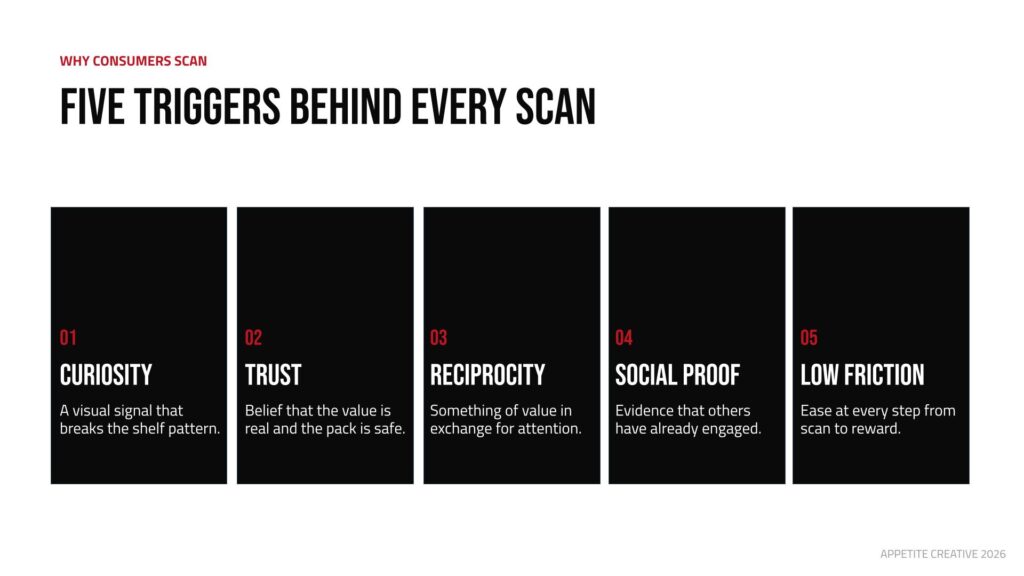
The bouncer’s VIP list is surprisingly predictable, featuring personalisation such as our own names, faces, food, cute things, anything dangerous or surprising, and anything that breaks a pattern we expect. Put one of these next to a QR code and the code gets noticed, which is why Guide Dogs has framed its code with an irresistibly cute dog and a charity for people with Crohn’s disease built its QR code out of toilet rolls. Retailer E-Mart went further still, creating a code from shadows that only formed when the sun hit just the right point in the sky.
This is where science and design meet, and Christel’s view is that shoppers have already filed away the standard black square on the side or back panel as ‘another link to a website or a recipe’. To be noticed, the code has to be disruptive and break the category’s design codes, much as food and dairy brands are now borrowing shapes, colours and flavours from cosmetics.
The challenge is doing that without cheapening the brand, because a QR code on the front of pack isn’t naturally attractive. It has to be designed into the brand’s story from the start, with the pack making clear that something worthwhile is waiting behind it.
Curiosity pulls people through
Attention gets a QR code noticed, and curiosity is what gets it scanned. The tension we feel when we don’t know the answer to something, known as the curiosity gap, is a powerful motivator. When people hear an out-of-place word in a sentence, such as ‘turtles are not as smart as mammals, such as socks or dogs’, brain activity spikes as the brain scrambles to make sense of it, which is the same reason Netflix cliffhangers work and people still listen to podcasts about Jack the Ripper.
The best QR campaigns harness that itch, as Calvin Klein did when it ran an ad marked as censored, with the uncensored version waiting behind a QR code. Coinbase ran a Super Bowl ad that was nothing but a QR code bouncing around the screen, which made it simple, intriguing and almost impossible not to scan.
Interaction adds another layer, because people value what they help create. IKEA lets people scan to see how furniture would look in their own home. Music executives were sent a cardboard turntable whose code played a track chosen specifically for them, combining curiosity, personalisation and interaction in one.
The lesson for packaging is that a QR code needs to promise to reveal, unlock or answer something, because that promise is what gives the shopper a reason to find out. A code that simply leads to a homepage has no curiosity built into it at all.
What’s in it for me?
Across the research on why people scan QR codes, one driver comes up repeatedly, and that is the benefit: whether the code offers useful information, makes life easier or gives the shopper something of value. Reframing around the audience works. It sounds obvious, but brands, like people, naturally start by talking about themselves.
Emotional rewards can be cheaper than free product and just as powerful. Cadbury’s Secret Santa let people send a chocolate bar to someone else, tapping into generosity and connection, and a billboard campaign that put scanners’ own photos on screen tapped into status and recognition.
The reward can also evolve over time because, as Christel points out, a connected QR code can change its content every time someone comes back. We’ve built journeys where the first scan delivers one piece of content and the second delivers something new, adding value each time without becoming invasive.
Context decides the moment
The same code performs very differently depending on where people are and what’s on their minds. Studies show a premium environment nudges people towards premium products, while images of money on a website push them towards the cheaper option.
The best campaigns match the moment, and a QR-enabled virtual supermarket in metro stations worked because commuters had time to kill and dinner on their minds. Pizza Hut’s AR game, unlocked by scanning the box, works because ordering a pizza puts people in a fun, indulgent mood.
Packaging adds a hard limit, because the QR code only lives as long as the pack, and it goes in the bin along with it. Brands get one chance, so the experience has to be designed for the moments the pack is actually in someone’s hands.
Creativity rooted in real insight
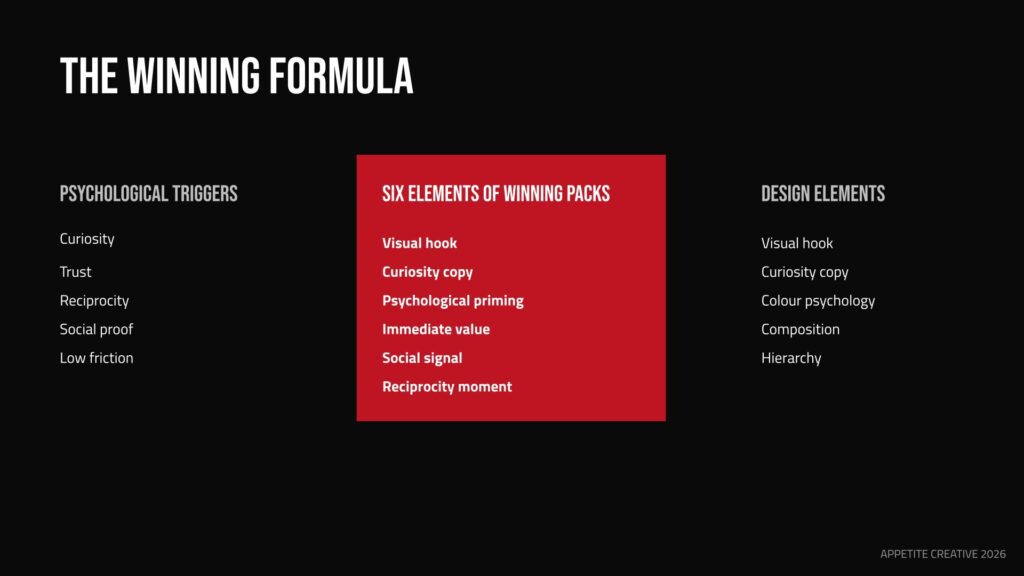
So, what should brands consider? Winning packs combine the psychology that makes people want to scan with the design that makes the code impossible to miss.
Ensure your QR code isn’t invisible, a tiny square tucked in a corner as an afterthought, with no link to the wider campaign and no benefit on offer won’t get a customer’s attention.
Don’t offer an empty reward, where a scan lands on a website and gives nothing back, which does more damage than a wasted scan. Even when something is free, getting less than we expected feels like a loss, and that disappointment attaches itself to the brand.
Instead, tap into tools like gamification which is increasingly popular. Our survey found 67.7% of respondents now incorporate gaming elements into their campaigns, up from 59% in 2025. Games are what psychologists call supernormal stimuli, taking mastery, reward and feedback and amplifying them beyond anything real life offers.
Gamified experiences we built for Bacardi held people for around three minutes, and for Sunny Oil, combining AI and gamification, around seven minutes, which is far longer than any brand would run a TV ad.
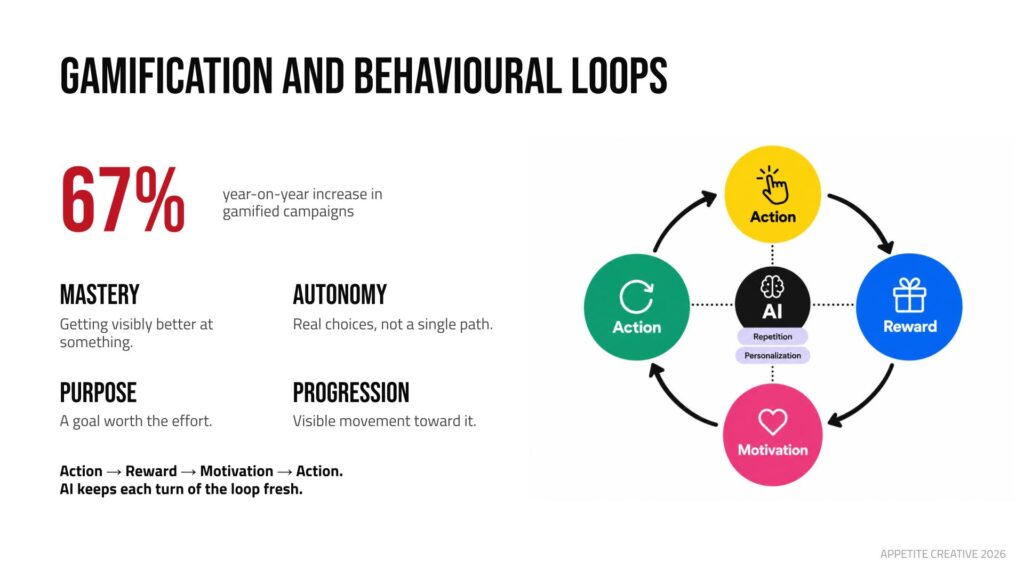
AI is also changing how packs are designed, and not always for the better. Christel sees clients run a brief through AI and get something that looks decent, only for the next brand to use the same prompt and get the same structure, look and feel. AI also can’t know the local story behind a brand, and in a category where milk is milk, what differentiates one brand from another is creativity rooted in real insight.
AI is changing how products are found too, as shoppers increasingly turn to AI tools to search for what they want. That means the copy on pack and behind the code needs to use the plain words consumers actually use when they prompt, avoiding language that is too conceptual or reads like a riddle.
Measure more than scans
Scan rate is the headline number, but if it’s all we measure, we’re doing ourselves a disservice, because time spent, repeat engagement and conversion tell you far more. Used well, a QR code becomes a measurable media platform, giving brands a much clearer picture than an in-store sampling booth, where you can only compare sales before and after.
The data can even feed new product development, so a brand launching a strawberry flavour could offer a small reward for voting on the next flavour to follow it. If nine in ten customers pick vanilla, the brand won’t waste money producing chocolate. That kind of insight can be critical, and it must of course be collected with permission and in line with GDPR and other data laws.
A framework to take away
My prediction is that before long the industry’s focus will move from scan rates to loyalty, measuring how many people come back, re-engage and build a relationship with the brand.
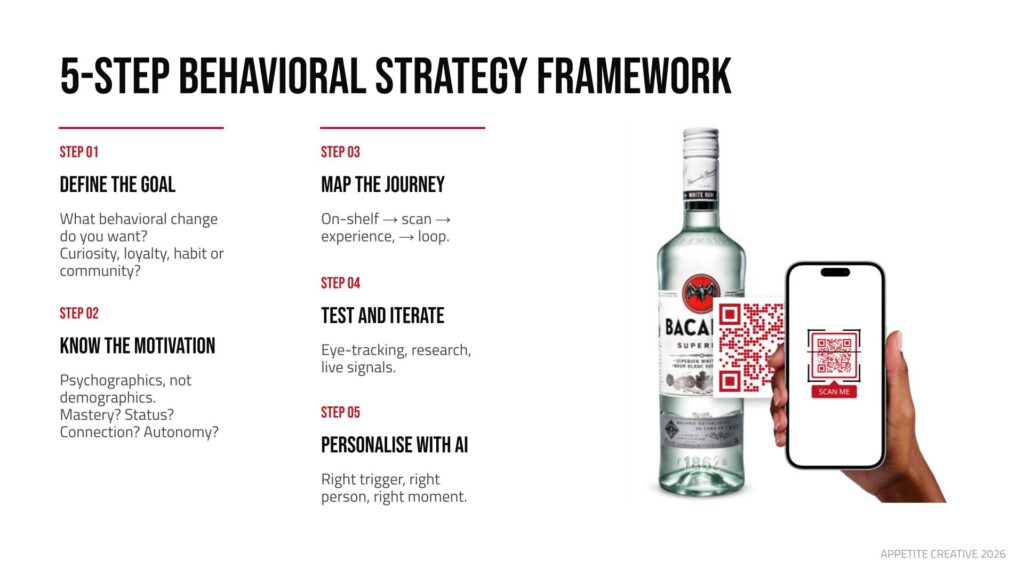
Key actions for brands wanting to get ahead, include:
- Define the goal of the scan before designing anything.
- Understand the motivation: what’s in it for the shopper.
- Map the journey from shelf to scan to experience, including how you’ll get past the bouncer.
- Test and iterate using live data.
- Personalise with AI so every scan, and every return visit, feels relevant.
Connected packaging already has the technology and the industry’s backing, and the brands that pull ahead will be the ones that design for the person holding the pack. That means a QR code that is striking enough to get past the brain’s bouncer, intriguing enough to spark curiosity and rewarding enough to answer, ‘what’s in it for me?’, delivered at the moment the shopper is ready to engage.
Get that right and the small square on a pack becomes a measurable media channel, a source of first-party insight and the start of a lasting relationship with customers. Putting a QR code on packaging has never been easier, and the brands that win will be the ones that understand what makes the person holding it want to scan.
About the Author
Jenny Stanley is the Managing Director of Appetite Creative, a company specialising in connected packaging and interactive digital brand experiences.
Her work focuses on how brands can connect physical products with digital engagement through technologies such as QR codes, gamification and interactive content. Through connected packaging, she explores opportunities for businesses to create meaningful consumer experiences, gather valuable first-party insights and strengthen customer relationships.
Jenny shares perspectives on consumer behaviour, creative innovation and the role of emerging technologies in transforming packaging into an interactive marketing channel.
For more information visit: appetitecreative.com
Continue the Conversation at The MarTech Summit
As the boundaries between physical and digital shopping experiences continue to blur, connected packaging is opening new opportunities for brands to engage with consumers beyond the point of purchase. As Jenny Stanley’s insights demonstrate, turning a simple QR code into a meaningful customer interaction requires more than technology. It demands an understanding of consumer psychology, creative design and the motivation behind every engagement.
At The MarTech Summit, we believe these practical perspectives are essential to shaping the future of marketing. Our global community brings together marketing, technology and business leaders to exchange real-world experiences, challenge conventional thinking and explore how innovation, data and creativity can build stronger customer relationships.
Join us at our upcoming summits across Singapore, Berlin, Paris, Stockholm, Madrid, Amsterdam, Manila, Hong Kong, Milan, Dubai, Bangkok, Kuala Lumpur and London, where industry leaders will share actionable strategies covering customer engagement, connected experiences, AI, gamification, data-driven marketing, brand loyalty and MarTech transformation.
Whether you’re exploring new ways to engage shoppers, looking to connect physical and digital customer journeys or seeking to turn consumer interactions into lasting relationships, The MarTech Summit offers a space for fresh perspectives, meaningful networking and practical ideas that can drive business growth.
Explore our upcoming events and be part of the global MarTech conversation.
➡ Interested in becoming a partner? Don’t hesitate to get in touch with us at sponsor@themartechsummit.com.
See more MarTech Thoughts interview pieces here!
Stay up to date with our In Person Summit, Session Information, and Agenda Updates by following us on:
Last updated: November 2026