
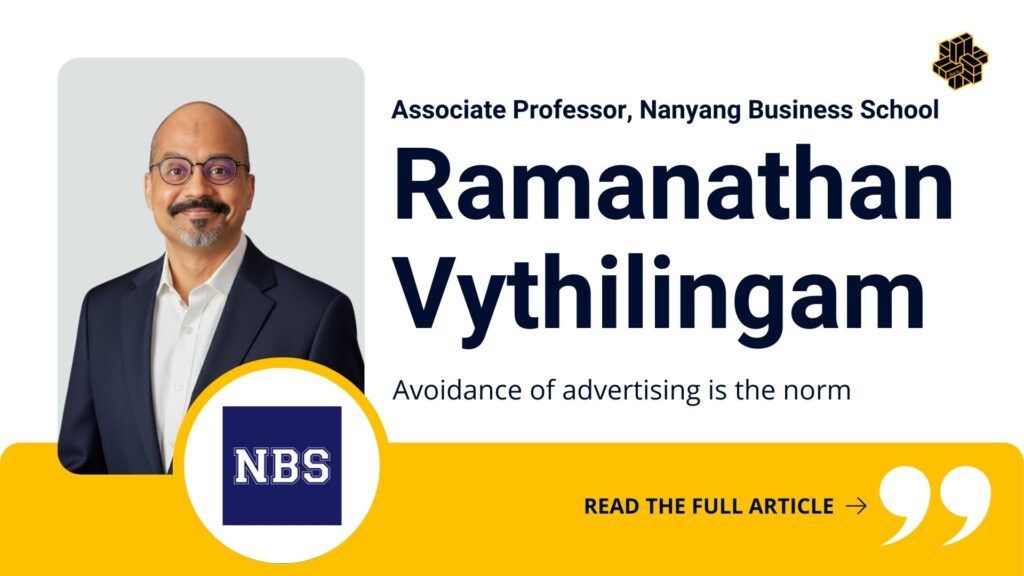
In an industry that often celebrates cinematic storytelling and award-winning craft, it is easy to forget a simple truth: most advertising does not live in a gallery. In this thought-provoking piece, Ramanathan Vythilingam invites marketers to reconsider how advertising truly works in today’s fragmented, low-attention environment. Drawing on his deep expertise in consumer insights, he contrasts the elegance of so-called Renaissance campaigns with the everyday reality of interruption advertising, and explains why effectiveness, not artistry alone, should guide creative decisions.
About Ramanathan Vythilingam:
Associate Professor, Nanyang Business School | Former Content Lead, Global Beauty Personal Care, Unilever
Deep and relevant experience in Consumer Insights, with experience working at both agency and client side of the business. Strong believer in a driving a holistic business understanding, and the role of Insights within the business narrative. Proven to deliver impact, working on regional category and global brand teams.
Why most ads aren’t Renaissance Paintings (and that’s okay)
A topic that should be discussed more is the need for Marketers to be cognizant of the reality to put themselves in the shoes of the people they are marketing to.
Reflecting on the recent debates around the relevance of Marketing Awards, after Cannes 2025, I was left feeling a bit ambivalent about the whole narrative. For a while now, I have struggled with unpacking learnings from award-winning cases, that I could then apply to my work. All the celebrated campaigns do not seem suited for the real-world context of diminished attention spans, low view-thru rates and the vagaries of the digital platform algorithms. They all feature an excessive focus on one aspect – that of the craft in making the ad film – usually a glossy high production value, long duration video, that leaves us with questions around the media channel plan that led to discovery and engagement, to then result in positive business outcomes.
The analogy that best describes this is – all the case study campaigns seem like Renaissance Paintings hanging in a museum, while the vast majority of ‘regular’ campaigns, are more akin to an outdoor hoarding, amidst the dust and pollution of the real world. Taking the analogy further, a Renaissance painting is one that people are actively willing to engage with, which an Outdoor hoarding is one that is actively avoided, at best it exists in the peripheral range of vision, as people go about their lives.
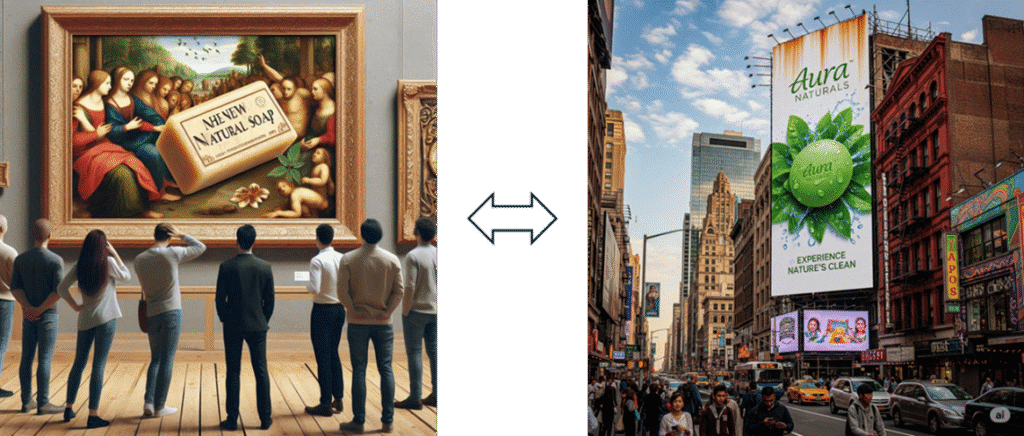
For any advertising campaign to be successful – as in positively impact the business – it requires the people it is intended to influence (the customers) to have an opportunity to see it and engage sufficiently with it to understand the Brand’s intent.
The ‘outdoor hoarding’ forms of advertising are essentially Interruption formats – they have to cut through the clutter by being interesting enough to catch attention and hold attention for a sufficient duration to land the brand’s intent. The majority of any brand’s advertising and media budget will be on Interruption formats of advertising. TV ads, pre-roll ads on YouTube, Brand posts in Instagram/TikTok feed, the banner ads on websites, audio ads in a podcast, print ads, out of home physical displays at bus-stops – are all interruption ads. These are the most efficient formats in terms of cost of media (usually measured as CPM – cost per 000 impressions)and when done well, will also be effective.
The formula for doing Interruption advertising well, starts with acknowledging that avoidance of advertising is the norm. To be effective, interruption ads need to be designed considering the viewing behaviour that is prevalent in each of the media channels. All of the creative best practices defined by the platforms consider this, more details can be found in online resources, some of them linked below –
- YouTube – the ABCD guidelines which are the recommended creative best practices to drive impact of advertising. (one of the guidelines is “Brand often and early”). (LINK).
- TikTok – study details the importance of the first 2-2.5s of TikTok videos in driving significant impact on Brand metrics (link).
- Meta – the latest guidance issued in 2025 is around the concept of “aggregated attention” and that “6s is the new 60s”(link)
In summary, interruption advertising needs to have the following features – short-form, attention grabbing from second zero, the Brand and Product must be integral to the narrative and simple, single-minded narratives that clearly communicate “which Brand, what product and what message”.
What about the craft of long-form storytelling, akin to the Renaissance painting approach? Are we saying that this has no role in building Brands? Not really – but given the reality of the content clutter that everyone is wading through, such forms of advertising need special care and need to be set-up to be “discovered”. As opposed to Interruption campaigns, such films need to be thought of as Seek-out – how do we generate sufficient interest, so people want to know more? We have to think of the approach as being similar to what trailers are to movies – a short duration trailer is intended to showcase what the movie is about and generate sufficient interest, for people to want to watch the whole movie.
But such campaigns are the exception and there is an important consideration around the types of stories that lend well to a Seek-out model. Just because brands have something to tell, does not mean people will want to watch the video. A well-designed trailer can only go so far. It still needs to be on a topic that resonates, ideally polarizes people – so it makes people want to know more. The best example for this is the Nike campaign in 2018 featuring Colin Kaepernick, which is discussed in Marketing circles via the hero film that is 126s long (link). The launch of the campaign started with a tweet on Twitter (now X) (link). This led to a barrage of online and offline discussion/debate – including Donald Trump who responded to the tweet, it got picked up by news channels, people shared posts of them burning their Nike shoes – all of which resulted in incredible amounts of word-of-mouth discovery. This made more people aware that there is a Nike campaign that everyone is talking about and generated interest to want to find out more. They then likely searched for “recent Nike campaign” – and found the video on YouTube and ended up watching the 2min+ video.
The long-form video itself did not get pushed into people’s FB/IG Feed or served as a pre-roll on YouTube. With people actively wanting to know more, this was a lean-in, actively engaged, high attention viewing, with the Brand already known.
The vast majority of campaigns that any Brand would do, are not of this nature. They would be interruption formats, that need to work despite the low attention, passive viewing mode they are subject to.
Ramanathan reminds us that strong marketing is not about creating masterpieces for recognition, but about designing communication that performs in the real world. While long-form storytelling has its place, most brands must compete in spaces defined by distraction, limited attention, and active avoidance. By understanding the difference between seek-out and interruption formats, marketers can align creativity with context and ensure their work drives genuine business impact.
Join Us Now!
Ready to elevate your marketing strategy? Be part of our Upcoming Events – where innovation, networking, and cutting-edge insights meet in vibrant cities around the world. We can’t wait to welcome you in person!
Can’t attend in person? No problem. Join BEETc On-Screen, our On-Demand Learning Platform, for exclusive access to 500+ sessions and over 300 hours of content from global summits. Upskill at your own pace, gain actionable insights, and stay ahead in a rapidly evolving business landscape.
Stay up to date with our In Person Summit, Session Information, and Agenda Updates by following us on:
See more MarTech Thoughts Content/ Interview pieces here!
Last updated:March 2026