
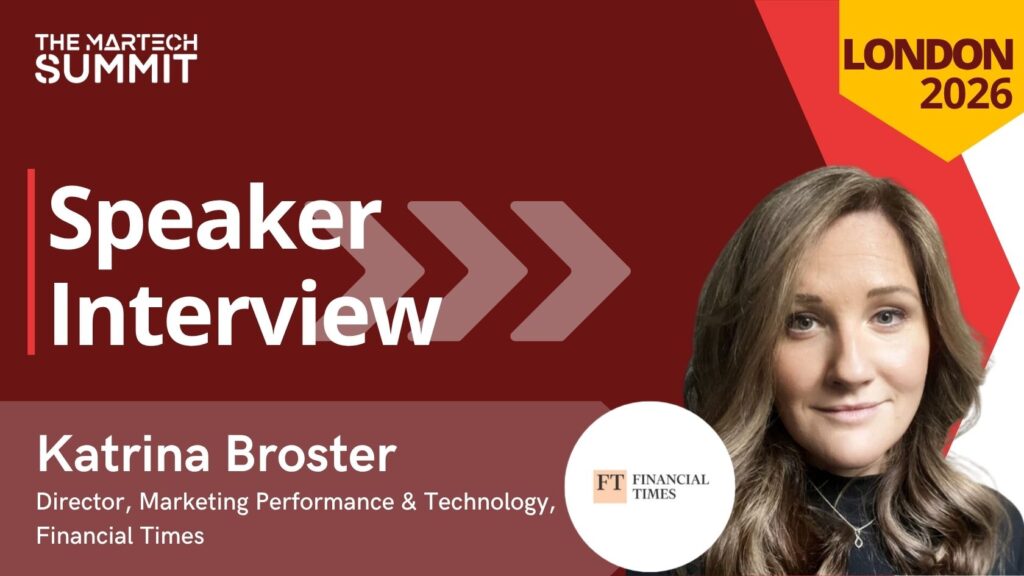
As marketing teams become increasingly data-driven, the challenge is no longer simply collecting more data, but turning it into decisions that create measurable commercial value. Ahead of The MarTech Summit London 2026, we spoke with Katrina Broster, Group Director of Performance & Marketing Technology at the Financial Times, about moving beyond efficiency metrics, strengthening first-party data foundations and bringing performance marketing, technology, AI and experimentation together to drive sustainable growth.
About Financial Times
The Financial Times (FT) is a global business and financial news organisation, providing journalism, analysis and information to audiences around the world. Through its digital and subscription-based business, the FT uses data, technology and experimentation to understand its audiences, improve customer experiences and support sustainable subscriber and revenue growth.
Quick Q&A with Katrina Broster
Could you please give us a quick introduction of yourself and share a bit about your role at Financial Times?
I’m Katrina Broster, Group Director of Performance & Marketing Technology at the Financial Times, where I lead a Centre of Excellence focused on driving audience, subscriber and revenue growth across the FT’s consumer and B2B subscription businesses.
I’ve spent over 15 years working in performance marketing, digital growth and marketing technology, predominantly in the media and publishing industry. My expertise spans quite a broad range of disciplines, from performance media and marketing measurement through to first-party data strategies, data privacy, conversion rate optimisation and digital customer experiences.
What really interests me is getting under the bonnet of what drives growth. I love understanding what works, what doesn’t and, importantly, why. I’m particularly passionate about the intersection of data, technology and customer behaviour, and how we can use those things to make smarter decisions, challenge conventional thinking and create better commercial outcomes. I’m a big believer in experimentation, robust measurement and using evidence rather than assumptions to guide investment and strategy.
More recently, my role has evolved from leading performance marketing into building the broader capabilities that enable sustainable growth across the FT. That means thinking not just about the campaigns we run, but the technology, data, measurement and digital experiences that underpin our ability to reach, engage and convert customers.
The other thing I’m hugely passionate about is people and leadership. I really enjoy building teams, bringing together different specialisms and creating an environment where people feel empowered to challenge ideas, experiment and do their best work. For me, one of the most rewarding parts of leadership is helping people develop, building a strong team culture and seeing what talented people can achieve when they’re working towards a shared ambition.
Ultimately, what drives me is a combination of solving complex problems, finding new opportunities for growth and building brilliant teams to make those opportunities a reality.
Why did you choose to participate in this summit?
I attend conferences and industry events because I genuinely love being inspired! I’m naturally curious and really enjoy hearing from other speakers, businesses and sectors about how they’re using data, technology and innovation to solve problems, challenge conventional thinking and drive growth. I always come away with pages of notes, new ideas and things I want to explore with my team.
I also think there’s enormous value in looking beyond your own industry. Some of the best ideas come from hearing how other organisations are approaching similar challenges, often in completely different ways.
At this stage in my career, I also feel I have a lot to contribute. I’ve been fortunate to build up a wealth of experience, and I’m passionate about sharing what I’ve learnt, including the successes, the challenges and the things that haven’t quite gone to plan. I’m also incredibly proud of the work we’re doing at the Financial Times, particularly how we’re bringing together data, technology and marketing to drive growth. It’s a great opportunity to share some of that work, exchange ideas with others and hopefully inspire a few people along the way.
What marketing metrics do you think senior leaders should pay more attention to – and which ones do marketers sometimes give too much importance to?
I think one of the biggest challenges in marketing is that we’re often optimising for efficiency rather than effectiveness. And those are two very different things.
Take customer acquisition. For years, performance marketing has been judged on its ability to acquire customers at the lowest possible cost. In fact, my own team is still targeted, in part, on cost per acquisition. On the surface, that sounds commercially sensible. But acquiring a customer cheaply doesn’t necessarily mean you’ve acquired a valuable customer.
You’re only really doing a good job if those customers stay, engage with your product and generate meaningful long-term value. I’ll give you a real example from the FT. When we first implemented our AI-driven paywall, we focused on metrics such as conversion rate and average revenue per user. All perfectly legitimate measures of performance, but they only told us part of the story. What we’ve learnt is that a dynamic, forward-looking measure of customer lifetime value is far more powerful. It forces us to consider not just whether someone subscribes today, but how likely they are to stay, how much revenue they’ll generate and what their relationship with the FT might look like over time.
And what’s really interesting is that when you change the metric, you change the decisions. You might find that a campaign generating fewer subscriptions is actually creating more value for the business. Or that a paywall experience with a lower immediate conversion rate is attracting customers who stay significantly longer.
The same principle applies to how we measure marketing investment more broadly. We place enormous emphasis on metrics such as clicks, impressions, cost per click and attributed conversions. They’re useful operational indicators, but they don’t necessarily tell us whether marketing is genuinely growing the business.
I’d love to see more senior leaders focusing on incrementality, customer lifetime value and the longer-term contribution marketing makes to growth. Are we generating demand that wouldn’t otherwise exist? Are we reaching new, valuable audiences? Are we improving customer retention? And are we building stronger foundations for future growth? This is particularly important when you consider brand investment. We know that brand activity can influence customer behaviour long before someone converts, but its contribution is often underrepresented in traditional attribution models. If we only measure the last interaction before purchase, we risk undervaluing the very activity that created the demand in the first place.
Can you share an example where data or experimentation challenged an assumption and led your team to make a different marketing decision?
A really good example is the work we’re doing on our AI-driven paywall, where data has fundamentally challenged our assumptions about where the greatest opportunity for growth lies. Our AI paywall uses machine learning to determine the most appropriate experience for a customer, based on their behaviour and likelihood to subscribe. It’s a sophisticated capability, and one that’s already delivering significant commercial value. For a long time, our thinking was that the next phase of growth would come from making the model even smarter. Improving its decision-making capabilities, experimenting with different paywall experiences, refining the user journey and optimising how we present our subscription propositions. All perfectly sensible areas to invest in. But when we undertook a detailed analysis of our paywall performance, we started to challenge that assumption.
What became clear was that our biggest opportunity wasn’t necessarily to make the AI more intelligent. It was to improve the quality and availability of the data we were feeding into it.
Like many businesses, we’re navigating an increasingly complex privacy landscape, with different levels of customer consent, fragmented data and limitations on how we can identify and understand our audiences. And the reality is that even the most sophisticated AI model can only be as effective as the data and signals available to it. If we can’t reliably recognise a customer, understand their behaviour or establish the appropriate permissions to use that information, we’re limiting the model’s ability to make effective decisions before it even gets started.
So we’re making quite a significant shift in our priorities.
Rather than putting all our energy into refining the algorithm or changing the paywall design, we’re focusing on strengthening our first-party data foundations: improving how we collect consent, the quality of the data we capture, and how consistently that information is made available to our decisioning technology.
The hypothesis is that by increasing the proportion of our audience we can responsibly recognise and understand, we can enable the existing AI model to make better decisions for more people, unlocking greater commercial value without necessarily needing to rebuild the technology itself. It’s a shift from optimising the experience at the point of conversion to improving the underlying capability that makes that experience effective in the first place. And I think there’s a much broader lesson here, particularly given how much businesses are investing in AI right now.
You lead the convergence of performance marketing, technology, AI, digital experience and measurement. What have you learnt about bringing these capabilities together rather than allowing them to operate as separate functions?
The biggest lesson for me is that the greatest opportunities for growth often sit between functions, not within them. Historically, marketing has tended to operate in silos. Performance media teams focus on acquisition, product teams on conversion, data teams on measurement and technology teams on building capabilities. Everyone can be doing a brilliant job individually, but that doesn’t necessarily mean we’re delivering the best outcome for the customer or the business.
What I’ve learnt is that bringing these disciplines together changes the questions you ask and the problems you solve. Instead of asking how we make a campaign more efficient, we can ask how we attract more valuable audiences, create better experiences for them and ultimately build longer-lasting customer relationships.
It also helps us move faster. We can identify an opportunity through our data, develop an experience, test it, measure its impact and apply what we’ve learnt without so many handovers or competing priorities.
But bringing capabilities together isn’t just about organisational structure. It’s about creating a shared understanding of what success looks like, encouraging different specialisms to challenge each other and building a culture where everyone feels responsible for the commercial outcome, not just their part of the process.
That’s really what I’m trying to build at the FT.
Looking ahead, what capability do you think marketing organisations need to build now if they want to become significantly more effective over the next few years?
I think the single most important capability is the ability to turn first-party data into intelligent, measurable and increasingly automated customer decisions. We’re entering a period where AI will fundamentally change how marketing operates, from how we identify audiences and allocate investment to how we personalise experiences and engage customers.
But I think there’s a danger that organisations rush towards AI without getting the foundations right. If your data is fragmented, your consent and privacy practices aren’t robust, or you can’t reliably measure commercial outcomes, adding more sophisticated technology isn’t necessarily going to make you more effective. I’d prioritise building a strong first-party data strategy, connecting that data across channels and customer experiences, and developing the measurement and experimentation capabilities to understand what genuinely creates incremental value.
And critically, I’d invest in people who can work across those disciplines. We need marketers who are commercially minded, comfortable with data and technology, curious about AI and confident enough to challenge what the numbers are telling them.
The competitive advantage won’t simply come from having the best AI tools. It will come from having the data, capabilities and people to make better decisions, faster, and continuously learn from the outcomes.
Katrina’s perspective highlights that better marketing does not necessarily come from more sophisticated technology. It comes from asking better questions, strengthening the data and measurement foundations underneath it, and bringing teams together around shared commercial outcomes. As AI continues to reshape marketing, organisations that combine strong first-party data, experimentation and commercially minded talent will be better positioned to make faster, smarter decisions.
Join Katrina and fellow marketing leaders at The MarTech Summit London, 10–11 November 2026, as we explore First-Party Data, AI and the Future of Marketing Measurement.
The MarTech Summit London – Smarter Stacks. Stronger Growth.
The MarTech Summit London returns this November as Europe’s flagship MarTech event, bringing together over 600 senior marketing, customer experience, digital, data and technology leaders for two days of practical learning, meaningful networking and forward-looking discussions on the future of marketing technology.
Designed for practitioners rather than product pitches, this year’s summit features more than 90 speakers, 30+ leading solution providers, and over 33 sessions across three stages, covering everything from AI-powered marketing and customer intelligence to first-party data, marketing operations, customer experience and revenue growth.
Whether you’re modernising your MarTech stack, scaling AI adoption or improving marketing performance, The MarTech Summit London is designed to provide practical ideas you can take back to your organisation.
Hosted once again at Convene 155 Bishopsgate, this closed-door summit creates an environment where senior decision-makers can openly discuss challenges, exchange ideas, and learn from one another.
➡ Interested in becoming a partner? Don’t hesitate to get in touch with us at sponsor@themartechsummit.com.
Can’t attend in person? No problem. Join BEETc On-Screen, our On-Demand Learning Platform, for exclusive access to 500+ sessions and over 300 hours of content from global summits. Upskill at your own pace, gain actionable insights, and stay ahead in a rapidly evolving business landscape.
Stay up to date with our Speaker Line-up, Session Information, and Agenda Updates by following us on:
See more MarTech Thoughts interview pieces here!
Last updated: October 2026