
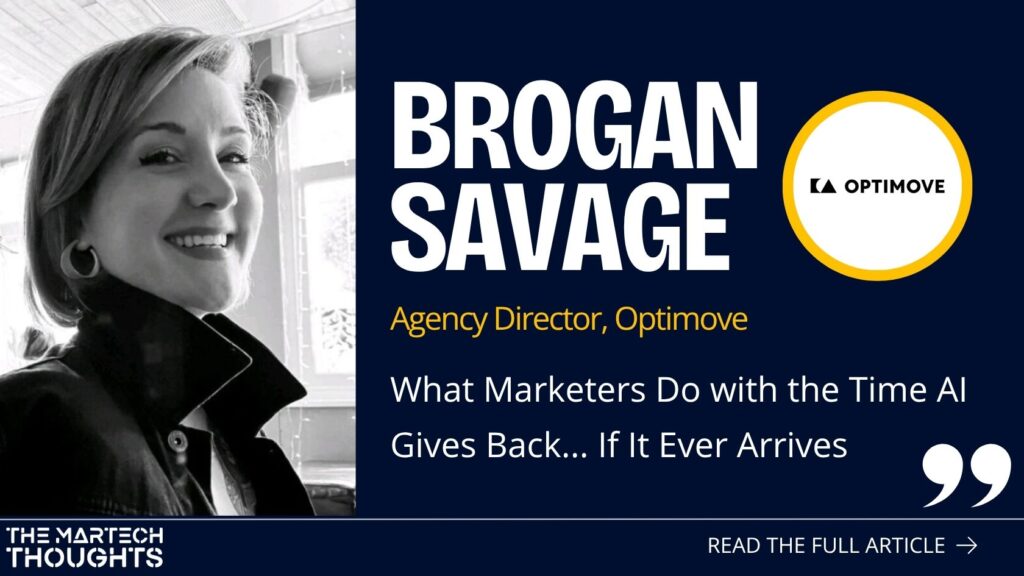
What Marketers Do with the Time AI Gives Back… If It Ever Arrives
By Brogan Savage, Agency Director, Optimove
I am a drummer. As a drummer, you hold the time everyone else plays against. Get it right and everybody feels supported by the drums, unnoticed. It is the undercurrent that carries the song.
Before any of that happens, somebody unloads the van, sets up the kit, tapes down the cables, checks the mics, and breaks the whole thing down again at one in the morning. That is also me. It is not drumming. For years I told myself it was part of the same job.
Marketing has the same split. There is the drumming, and there is the load-in.
The drumming is the marketing roadmap. Knowing which number matters and which one is noise. Deciding what a business should do next and being able to defend it. Holding the tempo of a replatform so nobody loses a day of sales.
The load-in is everything else. Pulling numbers out of four systems that disagree and reconciling them by hand. Rebuilding the same quarterly review structure for the eleventh time. Reformatting a chart because the blue was wrong. Writing a fourth subject line variant because someone wanted options. Spending most of Monday to compile a status report that gets skimmed in about four minutes.
I could not count the late nights I spent on the load-in. For clients. For conferences. For myself. For reasonable bosses, and unreasonable ones. Building decks past midnight does not give you a steady beat. It beats you down.
I was good at it, and that is the uncomfortable part. Being the person who could get it done overnight made me useful in a way everyone could see. So I let the load-in count as the job, and I built a fair amount of my professional identity on that work.
That work is what AI takes. Off your plate, and away from you.
The time usually does not arrive
Everyone talks about the hours AI gives back. Almost nobody talks about where those hours go. Most of the time, they go right back into the load-in.
You are not making the deck by hand anymore, so you make three decks. You are not writing the report, so now there are two reports and a dashboard. The volume rises to fill the space, and the thinking stays exactly where it was. That is the default. Unless somebody decides otherwise, faster assembly produces more assembly.
The time only arrives if you take it.
Control what you can control
Some of this is not up to you. Your company decides whether your AI connects to your data and platforms, or is just an account you paste things into. That decision involves budget, purchasing, and a security review, and most marketers reading this are not in that meeting. Make the case anyway. But accept that the call is not yours.
I have learned this the hard way. I have watched projects stall for reasons I couldn’t fix, and campaigns bring in plenty of visitors who never bought anything. What I took from it was to stop spending energy on what I couldn’t change and put it into what I could.
AI works the same way. You don’t control which tools your company buys. You do control the time those tools give you back.
Nobody is going to protect that time for you.
What to actually do with the time
If an analysis now takes an afternoon instead of three weeks, the real win isn’t the time saved. It’s that you can finally ask the questions you used to skip because they took too long to answer. Start there. Then:
Go deeper on how your business makes money. Get more insight of where the margins are, customer lifetime value by segment, what it costs to get each one. Most of us can describe our channel performance in detail but struggle with these. I did for years. It is why marketing teams get handed a budget instead of negotiating one.
Get closer to actual customers. Not a segment definition. Read the complaints. Listen to the calls. Nothing in an AI stack replaces knowing what your customer is annoyed about this month.
Decide what you are recommending before you open PowerPoint. Write the recommendation and the reason for it in three sentences. If you cannot, the deck will not save you. It will just take longer to unearth that recommendation.
Scrap something. Find the recurring report nobody opens and stop producing it. Creating it faster does not make it worth creating.
Which skills to let go, and which to build
The skills going away are the ones many of us were proudest of early in our careers. Building a great-looking deck. Being the person who knew where every file lived. Turning a messy export into something presentable by morning. Knowing a reporting tool better than anyone else on the team.
The one I am letting go is being the person who could get it done overnight. I was fast, I was reliable, and people knew it. That reputation got me hired more than once. It also cost me hundreds of evenings of work that made the company no money, and I am not going to defend it now just because I was good at it.
The skills to build are harder, and harder to show off.
Knowing which numbers matter. Not producing more of them. Looking at fourteen findings and being able to say which three the business should act on and holding that position when someone senior disagrees.
Knowing how your business makes money, well enough to negotiate your budget instead of just receiving it.
Knowing which of four decent options is right for this brand. That one takes years.
And a new one: directing AI work and checking it properly. This is not the same as knowing how to prompt. AI produces drafts. It does not send. Somebody has to be accountable for what goes out to a customer, and that somebody is you.
None of those can be learned overnight. They are built slowly, in exactly the hours you are currently spending on the load-in.
What is left
AI does not take the drumming. It takes the load-in.
The van, the cables, the breakdown at one in the morning. In marketing, that means the decks, the reformatting, the reports nobody reads. It took all night, so I mistook it for the job.
What is left is the part I wanted in the first place. Deciding what the business should do next and being able to defend it.
That work does not disappear. The hours around it come back. What you do with them is up to you.
Continue the Conversation at The MarTech Summit
As AI continues to reshape how customers discover, evaluate and choose brands, conversations like this are becoming an increasingly important part of modern MarTech strategy. At The MarTech Summit, our goal is to keep those conversations moving – bringing together marketers, technologists and industry leaders to exchange practical experiences, challenge established thinking and learn from one another. Join The MarTech Summit community for more insights from practitioners shaping the future of marketing technology, and continue the conversation face-to-face at our physical summits around the world.
Join us at our upcoming events across Stockholm, Amsterdam, Manila, Hong Kong, Bangkok, Singapore, London, Berlin, Jakarta, Paris, and Madrid, where industry leaders will share practical insights, real-world case studies, and future-facing strategies on AI, customer experience, data-driven marketing, brand loyalty, and MarTech transformation.
Whether you are looking to sharpen your marketing strategy, discover new technologies, or connect with peers facing similar challenges, The MarTech Summit offers a space for thoughtful conversations, meaningful networking, and actionable ideas that can help shape the next era of marketing.
Explore our upcoming events and be part of the global MarTech conversation.
➡ Interested in becoming a partner? Don’t hesitate to get in touch with us at sponsor@themartechsummit.com.
See more MarTech Thoughts interview pieces here!
Stay up to date with our In Person Summit, Session Information, and Agenda Updates by following us on:
Last updated: October 2026