
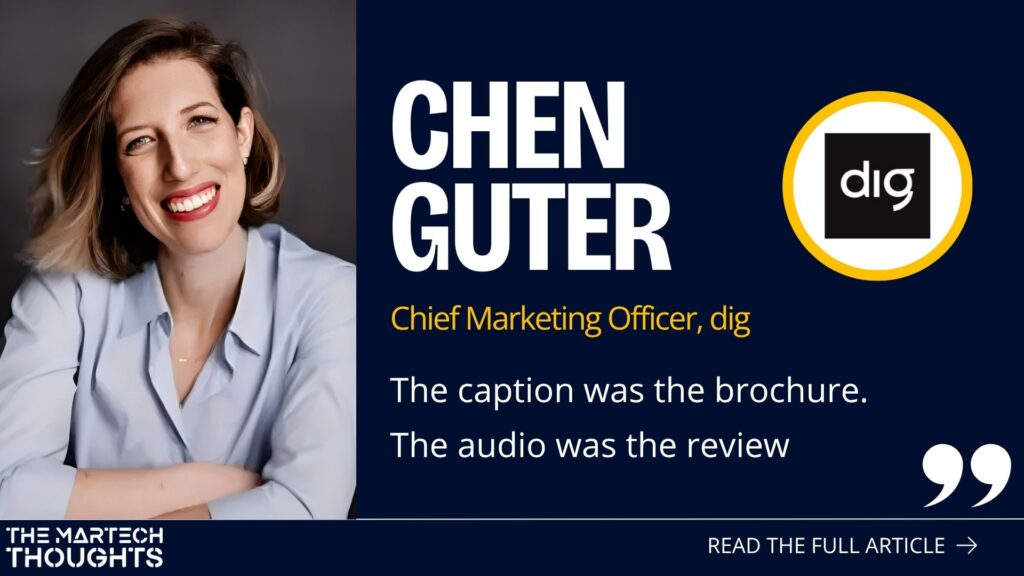
As AI-generated content floods social feeds, understanding what consumers genuinely think is becoming more challenging. Ahead of The MarTech Summit London, we spoke with Chen Guter, Chief Marketing Officer at dig, about the changing world of social intelligence, the limitations of traditional social listening and how marketers can uncover authentic consumer reactions hidden within comments, conversations and video content.
Quick Q&A with Chen Guter
Could you please tell us a little about yourself, your role as CMO at dig, and what excites you most about the way social intelligence is evolving right now?
I’m Chen, CMO at dig. I spent a decade at P&G on brands like Pampers, Tide and Pantene, then took on VP marketing roles at Lusha and AppsFlyer, bringing the science and glam of B2C brand building into B2B tech.
For most of those years I was also a buyer of social listening, and every tool I bought frustrated me. They counted mentions, sent alerts I stopped opening, and gave me a sentiment score that couldn’t tell sarcasm from praise. None of them could tell me why people felt the way they did.
That’s what excites me now. People react on video, and AI can read what they say on camera, how they say it and what they write underneath. A marketing team can finally ask why: why people hesitate, what they ask each other, what they’d buy if someone made it – without needing a focus group. It’s the tool I wanted when I was the buyer and I use it every day.
dig has recently launched a new set of social intelligence apps with Lovable. What problem were you trying to solve with this approach, and how is it different from the way marketers traditionally use social listening platforms?
People who own brand reputation share one frustration. Social listening is still built for one generic job: alerting on brand mentions. But their work is a dozen specific jobs. A global retail group in a crisis needs to know that a guest posted a video from one property in real time, that it’s spreading, and whether the same complaint is turning up in other countries. A listening tool hands them a keyword dashboard and leaves the rest to spreadsheets.
So we launched an app store inside dig. Every application is purpose-built for one job, like Product Benchmark, which compares your product against competitors across performance and consumer conversation, or Influencer Vetting, which helps discover rising creators based on your audience and brand criteria. When a team needs something new, we build it in days with Lovable.
Why did you choose to participate in this summit?
Marketing is evolving faster than at any point in my career. Customer expectations are changing, technology is advancing rapidly, and AI is reshaping how people discover information and engage with brands. I wanted to participate because it’s a great opportunity to share experiences with other marketers who are navigating similar challenges. The most valuable conversations often happen when we move beyond theory and talk honestly about what’s actually working, what’s changing, and how we can use technology to create better customer outcomes rather than simply more marketing activity.
Your keynote at The MarTech Summit London is titled “Real People, Fake Internet”. As AI-generated content becomes more common across social feeds, what do you think marketers are most at risk of misunderstanding about consumer sentiment?
The biggest risk is mistaking volume for opinion. More and more of what sits in the feed is AI-generated, recycled or amplified, so the content itself tells you less and less about what real people think. Before you read any sentiment, you need to know what’s authentic and what isn’t.
Real opinion lives in the reaction layer: the comment someone bothered to type, the stitch where they argue back, the reaction video with their face in it. Bots comment too, so you still have to read critically. Genuine reactions are specific, varied and tied to a moment.
The second risk is assuming the caption is the message. In one analysis we ran on Disney content on TikTok, the word “expensive” appeared zero times in captions and 14 times in what people said on camera. The caption was the brochure. The audio was the review. If your tools only read text, the brochure is all you’re reading.
AI-generated summaries can make huge volumes of social data easier to understand, but can they also flatten or distort what people are really saying? What should marketers look out for when trying to separate genuine sentiment from synthetic or coordinated engagement?
They can. For example, we read 56,071 US posts about GLP-1 weight-loss medication, and they tell a five-stage story. It starts with curiosity and dread. Then the onset shock (appetite gone, nausea, food tasting wrong), the loudest stage of the whole journey. Then a long stretch of people asking each other under the videos, “what do I actually eat now?” It ends with people saying the food noise finally stopped.
Summaries inherit whatever went into them. If part of the conversation is coordinated, the summary reports it as consensus, in one calm, confident sentence. So check how many different accounts sit behind a finding, and trace the most viral videos before you trust a summary of a thousand.
What are some of the signals that suggest a conversation is genuinely organic rather than coordinated, bot-driven or artificially amplified? And how much can synthetic engagement skew the conclusions brands draw from social data?
Organic conversation is messy. People disagree, wander off-topic, misspell things and mention something specific that happened to them. Coordinated activity tends to be tidy: similar phrasing across many accounts, posts landing in tight bursts, thin or brand-new profiles, and engagement that spikes without a matching rise in real replies.
The strongest signal is the reply chain. Real people argue back, ask follow-ups and tag their friends. Bot activity rarely produces a conversation underneath it.
How much can it skew things? Enough to change a decision. A coordinated push can make a fringe complaint look like a backlash, or a quiet product look loved, and the number on the dashboard looks exactly the same either way. Before a social insight goes into a board deck, someone should be able to say how much of it came from distinct, real people, and what they actually said.
Comments sections are often treated as noise, yet they can contain some of the most candid customer feedback. What kinds of unmet needs, frustrations or product opportunities have you seen brands uncover from unprompted audience reactions?
Two favourites. In GLP-1 weight-loss medication, we read the comments under the videos as a live Q&A and coded the questions. What to eat came up 1,639 times, the protein gap 1,124, feeling full too fast 996, nausea 981, hydration 762. None of those questions names a brand, so keyword listening misses every one. And the people answering are nurses and other patients. That’s a product and content brief, written by the market, for any food or wellness brand willing to show up.
With Klarna, people were trading workarounds in the comments: buying small to “build trust” with the app, closing accounts before a mortgage application, spreading purchases across apps. Whether those beliefs are right barely matters. People act on them, which shows the brand exactly where its product is misunderstood. A survey would never have thought to ask.
For marketers who want to improve the way they use social intelligence today, what should they start paying attention to beyond mentions, likes and engagement rates?
Three habits I would take on, none of which needs a budget.
Start with the authentic voices in the comments. The caption is what the creator or brand meant to say. The comments are what the audience heard.
Vet creators on how their audience reacts. Follower counts and likes are easy to inflate. Look at whether people reply with real questions, tag friends, push back or say they bought. In categories we’ve analysed, some of the most influential voices have a few thousand followers and an audience that replies with questions and says they bought.
And spend one week reading your category with your brand name switched off. Most of the conversation shaping your market never mentions you. What you find there is your real exposure, and your real opportunity.
Mentions tell you something moved. Reactions tell you why, and what to do next.
Chen’s perspective highlights a growing challenge for marketers: more social data does not necessarily mean a clearer understanding of consumers. As AI-generated and amplified content continues to grow, marketers need to look beyond surface-level metrics and pay closer attention to authentic reactions, conversations and the context behind them.
Continue the Conversation at The MarTech Summit London
Join Chen Guter at The MarTech Summit London for her keynote, “Real People, Fake Internet: Finding Authentic Insights in an AI-Flooded Feed”, where she will explore how brands can use social intelligence to uncover what consumers really think, feel and do.
See more MarTech Thoughts interview pieces here!
Stay up to date with our In Person Summit, Session Information, and Agenda Updates by following us on:
➡ Interested in becoming a partner? Don’t hesitate to get in touch with us at sponsor@themartechsummit.com.
Last updated: October 2026