
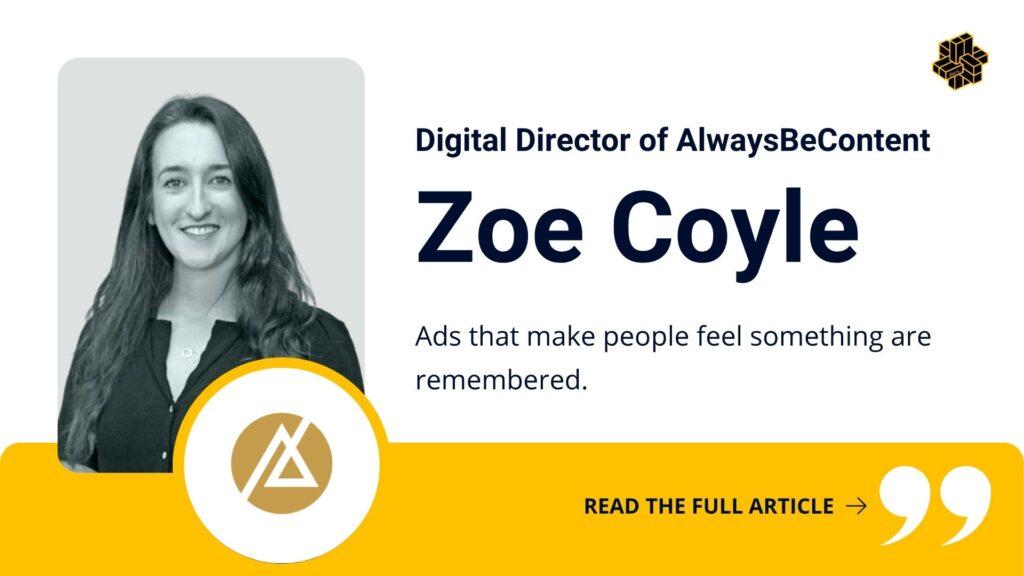
In today’s B2B landscape, speed is rarely the real problem. Connection is. Funnels are optimised, targeting is precise, and performance metrics are tracked with rigour – yet many brands still struggle to build lasting impact. In this insightful piece, Zoe Coyle explores why B2B growth cannot rely on rational, conversion-led marketing alone. Drawing on her experience across B2B technology and financial services, she challenges marketers to rethink the balance between performance and brand building, and shows how emotional connection plays a critical role in shaping trust, memory, and long-term demand.
About the Author:
Zoe Coyle is a senior marketing leader with extensive experience across B2B technology, financial services, and agency environments. Currently Digital Director at AlwaysBeContent, a B-Corp based in Edinburgh, she specialises in integrated campaigns spanning content, paid media, and brand strategy. Zoe is known for navigating complex B2B landscapes where long buying cycles and sophisticated audiences demand both strategic clarity and strong commercial impact.
Reframing the B2B Challenge: Why Growth Is Ultimately a Human Decision

For the past decade, B2B marketing has been optimised for speed.
Faster funnels. Shorter sales cycles. Precision targeting and aggressive conversion tactics. Success has been defined by how efficiently brands can capture existing demand and push it through the pipeline.
In practice, this has led to an overwhelming reliance on rational, product-led advertising: features, pricing, proof points, offers. Marketing designed to persuade quickly, measure cleanly, and justify itself easily.
Like hunters, B2B brands have spent years tracking prospects online, aiming to strike at the exact moment they show intent.
That approach worked – for a while.
But as B2B markets advance, the conditions that supported this model have fundamentally changed.
A Tougher Environment – Not a Smarter One
We’re operating in what’s increasingly described as a polycrisis: ongoing geopolitical instability, economic pressure, cost-of-living challenges, and rapid technological change.
Businesses are understandably cautious. Under pressure to prove short-term value, marketing teams are retreating into what feels safest: performance media, bottom-of-funnel tactics and highly rational creative.
Ironically, this collective retreat into measurability is making B2B marketing less effective, not more.
Peter Field’s research consistently shows that over-weighting short-term, sales-driven messaging leads to declining effectiveness over time.
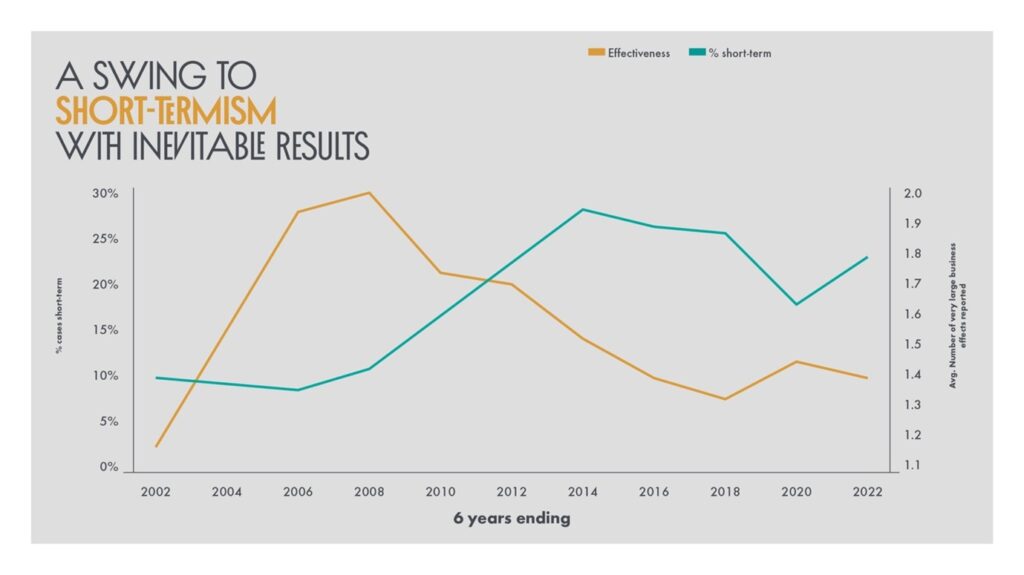
Brands that prioritise immediate conversion at the expense of long-term brand building see diminishing returns – even as spend increases. The issue isn’t that rational advertising doesn’t work.
It’s that it only works in very specific circumstances.
The 95% Problem: The Reality of B2B Buying Cycles
One of the most important – and most ignored – realities in B2B marketing is that most of your audience is not in the market to buy.
At any given moment, roughly 95% of potential B2B buyers aren’t actively looking for a solution. They’re not researching vendors, comparing features, or downloading whitepapers.
Historically, that might have been manageable. Today, that challenge is more acute than ever.
Buying cycles are longer – decision-making has stretched by 54 days since 2021, according to Dentsu’s Superpowers Index.
Buying groups are significantly larger – up to 13 people in 2025, involving more stakeholders with differing priorities.
Digital noise continues to rise, with B2B ad spend increasing year on year – projected to reach 23B USD in the US alone in 2026, according to Statista.
And trust has become the dominant decision driver, as buyers look to minimise personal and professional risk.
The result is a narrower window of opportunity, involving more sceptical decision-makers, in a more competitive and expensive environment.
This is not a context where louder rational messaging wins.
Why Rational Advertising Falls Short
There is a role for rational, functional advertising in B2B.
When buyers are actively in market, information matters. Product features, benefits, comparisons, reviews, and proof points are critical inputs into decision-making. At this stage, creativity is not the priority – clarity is.
Data shows that rational ads can be highly effective at converting existing demand.
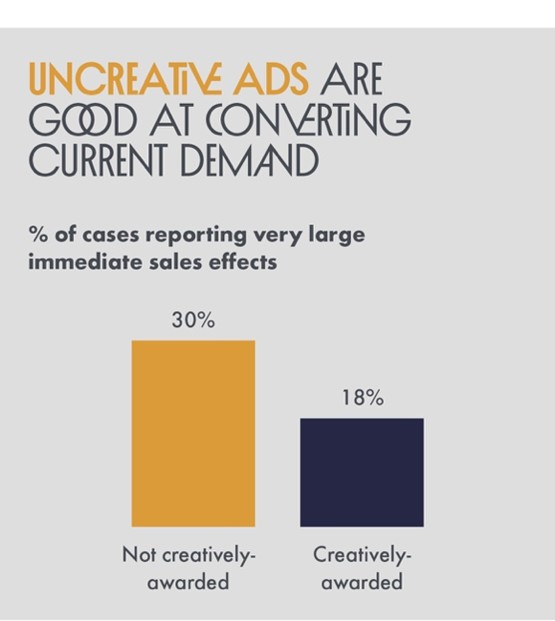
But for everyone else – the vast majority – this level of information is simply ignored. If you’re not actively buying, you’re not reading detailed product messaging, no matter how well targeted it is.
Which raises a critical question: How do brands influence future buyers before they enter the market?
The answer requires a shift in mindset.
From Hunting to Farming: Rethinking How B2B Growth Is Built
B2B marketers have spent years optimising for hunting – identifying active prospects and closing them as efficiently as possible.
But in today’s environment, growth depends far more on farming: cultivating long-term demand, familiarity and trust across a broad audience over time.
This is where brand building – and specifically emotional advertising – becomes essential.
People are far more likely to buy from brands they recognise, feel familiar with and trust before they begin a formal buying process. That familiarity acts as a shortcut in complex, high-risk decisions. It reduces perceived risk, smooths internal consensus, and increases the likelihood that rational sales messages will land when the time comes.
And familiarity is not built through information alone.
It’s built through emotional resonance.
Emotion Is Not the Opposite of Logic
In B2B, emotion is often misunderstood as being at odds with rational decision-making. In reality, it underpins it.
B2B buyers are people making high-stakes decisions under pressure. Their choices affect budgets, careers and reputations. Emotional responses – particularly confidence, safety and reassurance – play a central role in how brands are evaluated.
Research consistently shows that advertising which elicits positive emotional responses is far more effective at building long-term memory structures than neutral or purely informational messaging.
Ads that make people feel something are remembered.
Ads that make people feel nothing are forgotten.
This matters because memory is what shapes preference when buyers eventually enter the market.
In increasingly crowded categories, the brands that win are not the ones that explained themselves best at the last moment – but the ones that had already earned a place in the buyer’s mind.
Creativity as a Growth Multiplier
Creative, emotionally engaging advertising has been shown to significantly outperform non-creative, rational advertising when it comes to long-term outcomes like market share growth and brand strength.
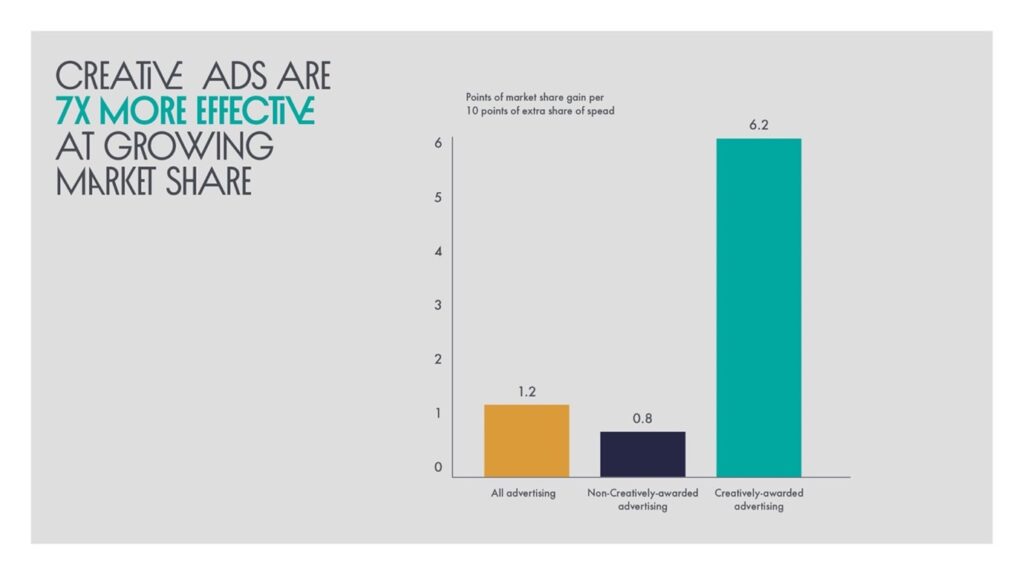
This isn’t about entertainment for its own sake. It’s about earning attention, cutting through noise, and creating distinctive brand cues that stick.
In an era where AI can generate endless variations of rational messaging at scale, human connection becomes the true differentiator. Creativity signals confidence. Emotion signals credibility. And both help brands feel more human in categories that too often feel interchangeable.
Importantly, this doesn’t mean abandoning performance marketing or rational messaging altogether.
The most effective B2B strategies don’t choose between emotion and logic – they sequence them.
Building Brands Buyers Already Trust
B2B marketing didn’t become rational because it was more effective.
It became rational because it was easier to justify.
Of course, in uncertain times, brands gravitate toward what feels safe: metrics, attribution, and short-term results. But the brands that grow sustainably are the ones willing to invest beyond the immediate moment.
Performance marketing converts existing demand.
Brand building creates future demand.
And emotional connection is what makes both work harder.
As buying cycles lengthen and buying groups expand, B2B brands must move beyond the illusion that speed alone drives growth.
The challenge now is not to optimise faster – but to connect earlier.
Because when buyers finally enter the market, they don’t choose the brand that explained itself best. They choose the one that already feels familiar and credible.
And that decision is far more human than we often like to admit.
As B2B buying becomes more complex and risk-driven, the brands that succeed will be those that invest in both logic and emotion. Rational messaging may convert demand, but it is emotional connection that creates it in the first place. This article reminds us that growth is not just about capturing intent in the moment, but about shaping perception long before the buying journey begins. In the end, even in B2B, decisions are made by people—and people choose what feels familiar, credible, and trusted.
Join Us Now!
Ready to elevate your marketing strategy? Be part of our Upcoming Events – where innovation, networking, and cutting-edge insights meet in vibrant cities around the world. We can’t wait to welcome you in person!
Can’t attend in person? No problem. Join BEETc On-Screen, our On-Demand Learning Platform, for exclusive access to 500+ sessions and over 300 hours of content from global summits. Upskill at your own pace, gain actionable insights, and stay ahead in a rapidly evolving business landscape.
Stay up to date with our In Person Summit, Session Information, and Agenda Updates by following us on:
See more MarTech Thoughts Content/ Interview pieces here!
Disclaimer: Views expressed in this article are solely those of the author and do not necessarily reflect the positions of any organisation, employer, publisher, or affiliated entity. Any references to products, services, or individuals are for informational purposes and do not constitute endorsement.
Last updated:April 2026