
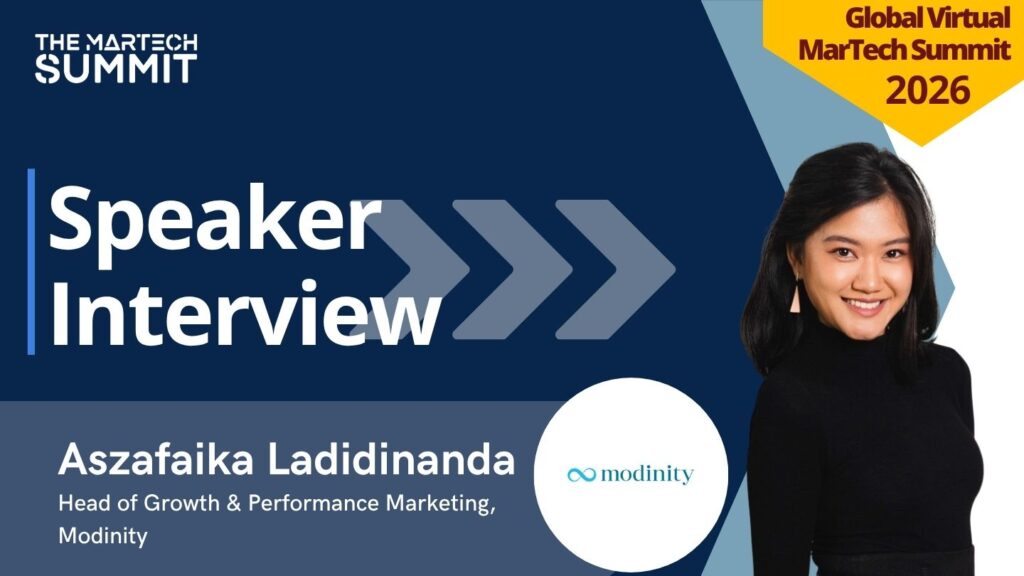
Growth today rarely happens within a single channel. Customers move between social media, marketplaces, websites, messaging platforms and physical stores, while marketing teams need to understand how those interactions connect to commercial performance. Ahead of the Global Virtual MarTech Summit, we spoke with Aszafaika Ladidinanda, Head of Growth & Performance Marketing at Modinity, about navigating this increasingly connected customer journey. Drawing on her unconventional path from architecture to digital marketing, Aszafaika shares how critical thinking shapes her approach to growth, why brands should protect their identity as platforms evolve, and the importance of looking beyond individual channel dashboards to understand the wider business.
About Modinity
Modinity is a multi-brand fashion and lifestyle company whose portfolio includes Buttonscarves, a premium modest fashion brand originating in Indonesia. Operating across digital commerce, marketplaces, social platforms and physical retail, the business serves customers through multiple interconnected touchpoints.
Its growth environment brings together performance marketing, e-commerce, merchandising, content and commercial decision-making, requiring marketing teams to connect customer behaviour with wider business factors such as stock and P&L performance. For Aszafaika, this means approaching digital performance not as an isolated marketing function, but as a discipline that sits at the centre of the wider business.
Quick Q&A with Aszafaika Ladidinanda
Could you please give us a quick introduction of yourself and share a bit about your role at Modinity?
I started with Buttonscarves in 2018 as an external consultant, running digital end-to-end while the brand was still building its growth engine. Premium modest fashion in Indonesia grew far faster than anyone predicted, and Buttonscarves is now recognised well beyond the region. I returned in 2025, this time in-house, leading digital performance marketing across Modinity’s brand portfolio. The part I enjoy most is that the role sits at the centre of the business, connecting what Finance sees in the P&L, what Merchandising sees in stock, and what E-commerce, Marcom, and content are each building.
Why did you choose to participate in this summit?
I am drawn to conversations that are genuinely customer-centric, particularly ones where the same problem gets examined from different roles and different vantage points. The most valuable thing in any room is honest sharing, because that is the moment you realise your own way of seeing has blind spots. I would rather leave a summit with a sharper question than a confirmation of what I already believed. That is the exchange I am here for.
Your background is in architecture before moving into digital marketing. How has that journey influenced the way you approach problem-solving, customer experience, and marketing strategy?
Architecture trains you to hold feasibility and imagination at the same time. You study the constraints seriously, then design within them rather than around them. That habit transfers directly. I examine a problem from every side before deciding what to fix, which usually surfaces both the gap nobody has patched and the opportunity nobody has tried. I think I am just weird enough to see the door before everyone else notices the wall. The end goal is the same discipline either way: understand what people actually need, then build something that meets it.
Social commerce continues to evolve rapidly. What do you think brands need to do differently to turn social engagement into real purchasing behaviour?
Be honest first. People trust honest people, and customers read brands exactly the same way. In a landscape moving this fast, too many brands follow the current until they lose their identity and the original reason they created the product. My view is to strengthen what you already own, protect the quality, and deliver it in a way that earns attention without distorting the truth. Selling for the sake of selling does not survive the next two or three platform shifts.
What is the biggest obstacle to building a unified customer view in a multi-brand, multi-channel business?
The same person can be a marketplace buyer, a WhatsApp subscriber, a website session, and a store visitor, and in most systems those are four different people. Identity fragmentation is not a reporting inconvenience; it quietly distorts what you believe about acquisition and retention. Before any sophisticated modelling, we invest in the unglamorous layer: consistent tagging, consistent definitions, and one agreed answer to what counts as a new customer. Without that foundation, a unified view is just a dashboard, not a truth.
Can you share one personal or professional goal you’d like to achieve in 2026?
To stay present. Genuinely paying attention to what is happening across the business rather than only inside my own channel dashboards, and bringing a distinctive touch to how we market. The other half is alignment. I want every department to read marketing impact in the same terms, because we are not building the brand in isolation. We are building it together, and with our customers.
Aszafaika’s perspective brings growth marketing back to something fundamental: understanding what customers actually need and making it easier for them to act. Whether that means connecting fragmented touchpoints, strengthening the foundations behind customer data or resisting the temptation to follow every new platform trend, effective growth requires teams to see beyond their individual channels.
Her architectural background offers a fitting way to think about modern marketing – understand the constraints, examine the problem from every angle, and then build something that works for the people using it.
As Aszafaika puts it, “We are not building the brand in isolation. We are building it together, and with our customers.”
Join us at the Global Virtual MarTech Summit to discover more perspectives from marketing leaders navigating growth, customer experience, data and the changing digital landscape.
Global Virtual MarTech Summit APAC & EMEA
Global Virtual MarTech Summit APAC & EMEA, where leading marketing professionals gather to explore this year’s theme: The Real-Time Customer.
As customer expectations continue to rise, brands across APAC and EMEA are under increasing pressure to connect data, AI and customer engagement in more meaningful, timely and measurable ways. This summit will spotlight practical strategies, real-world use cases and regional perspectives on how marketing teams can move closer to real-time customer understanding and action.
➡ Interested in becoming a partner? Don’t hesitate to get in touch with us at sponsor@themartechsummit.com.
Can’t attend in person? No problem. Join BEETc On-Screen, our On-Demand Learning Platform, for exclusive access to 500+ sessions and over 300 hours of content from global summits. Upskill at your own pace, gain actionable insights, and stay ahead in a rapidly evolving business landscape.
Stay up to date with our Speaker Line-up, Session Information, and Agenda Updates by following us on:
See more MarTech Thoughts interview pieces here!
Last updated: August 2026