
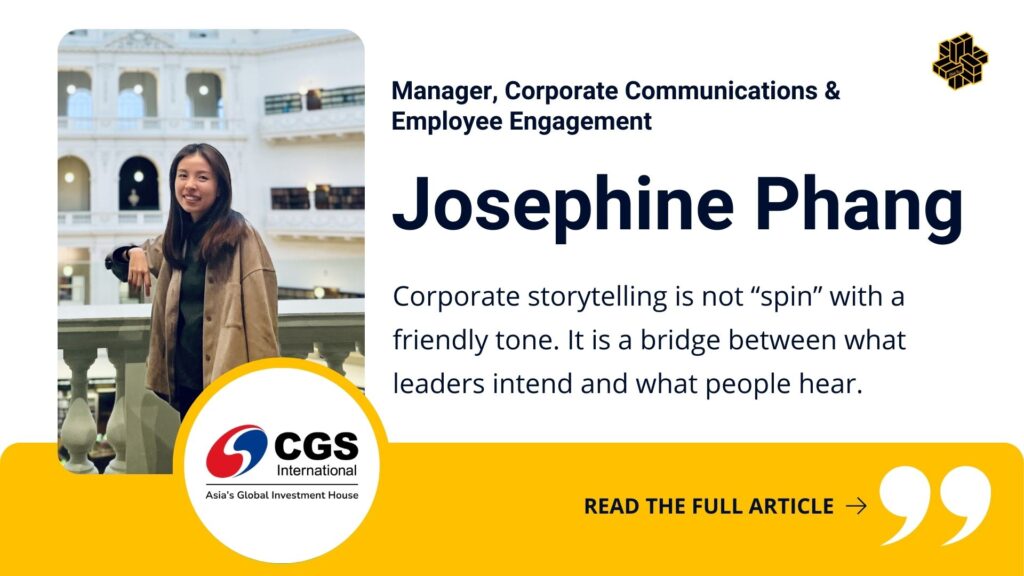
In today’s organisations, information is rarely the problem. Meaning is. Strategy decks, town halls, and transformation roadmaps are often delivered with precision, yet employees still feel uncertain or disengaged. In this insightful piece, Josephine Phang explores why storytelling is not a soft skill or corporate embellishment, but a strategic discipline. Drawing on her experience in corporate communications and employee engagement, she explains how narrative design helps organisations build alignment, shape culture, and make direction portable long after the meeting ends.
About the Author:
A copywriter turned corporate communications specialist, Josephine Phang (“Josie”) helps organisations and teams turn strategy into stories. Building on her knowledge in advertising and marketing, she blends editorial rigour with empathy, ensuring messages land with clarity across diverse audiences and channels.
Currently at CGS International, she builds employer branding campaigns that drive leadership narratives that keep employees engaged across in-person and online events. Known for crisp writing, clear structure, and measurable outcomes, Josie partners with leaders to align culture, spark change, and drive performance.
She believes storytelling is not just a tool for brands to stand out in the marketplace, but a powerful habit that organisations should leverage to build credibility with intention, shaping perception and rallying diverse teams towards one direction. After all, internal narrative is brand narrative; both employ the same principles, the only difference being audience stakes.
Corporate Storytelling: Why It Matters and How to Do It
Most organisations don’t suffer from a lack of information. They suffer from a lack of meaning.
You can publish a strategy deck, circulate a transformation roadmap, and host two town halls a quarter—and still find that people are confused, sceptical, or simply disengaged.
That disconnect rarely comes from the plan itself. It comes from the fact that humans don’t organise their world through PowerPoint decks. We organise it through narrative.
What corporate storytelling actually is (and what it isn’t)
Let’s clear away some unhelpful myths.
Corporate storytelling is not:
- A substitute for data or evidence
- Making everything sound inspirational
- Turning business updates into personal confessionals
Corporate storytelling is:
- A method for making strategy memorable
- A structured way to communicate meaning
- A tool for alignment and momentum
Think of it as narrative design: you’re shaping how people make sense of the organisation’s direction – not by controlling every detail, but by offering a clear storyline that can travel.
Why storytelling matters in organisations, in three pointers
1) People remember stories long after they forget slides
Our brains don’t retain information because it’s accurate; we retain it because it’s salient. Stories have built-in features that make them sticky: sequences, tension, cause-and-effect, and emotional signals that tell us what matters.
In experiments run by researchers from Harvard Business School and the University of Cologne, the influence of statistical information decayed far more after a delay, as compared to the influence of a story, suggesting narratives remain more retrievable in memory over time*.
You’ve probably experienced this yourself. You might not recall a long list of quarterly metrics, but you can remember an example of a customer struggling, a team pulling together under pressure, or a leader making a difficult call. Those narratives create mental “hooks” that plain facts rarely do.
Storytelling is not an alternative to rigour. It’s a way to make rigour usable.
2) Change fails when the narrative is missing
Here’s the truth: your organisation will have a story about your change management initiative whether you supply one or not.
If leaders don’t give people a coherent narrative, employees will build their own, using watercooler talks, worst-case assumptions, and selective memory.
In that vacuum, the unofficial storyline tends to sound like:
- “This is just cost-cutting, again.”
- “Leadership doesn’t understand our reality.”
- “They’ll change their minds again in six months.”
A clear corporate story doesn’t remove uncertainty, but it reduces fear and unnecessary corridor commentary. It gives people a shared frame for what’s changing, what’s staying, and what they’re being asked to contribute.
3) The way organisations speak about failure shapes trust
Trust is rarely built through credentials alone. People decide whether to trust leaders based on whether they understand them; how much leaders know about “living a day in their shoes”.
Enter failure stories. When handled with care, stories about setbacks are often more influential than the stories you tell about success.
A failure story, can:
- demonstrate accountability without self-blame
- encourage teams to surface problems sooner
- normalise learning/problem solving (“OK, so what’s next”)
Corporate storytelling isn’t about adding a “human touch” to comms for the sake of it. It is a practical way for leadership to build trust and shape culture. It is an important tool to help people understand what’s happening, remember what matters, and decide how they’ll respond.
The three levels of corporate storytelling
Organisations that communicate well don’t rely on one “big story”. They build a simple ecosystem of stories that reinforce one another.
Level 1: Organisational narrative
The “why” and “where”. This is the overarching storyline, the big picture. What the organisation is trying to do, why it matters, and what the future looks like.
Level 2: Leader’s anchor story
The “who”. Every senior leader benefits from an anchor narrative—a short, repeatable story that helps people understand what drives them, what they value, and how they make decisions.
Level 3: Everyday stories
The “proof”. These are concrete examples that make the big narrative believable: reviews from customers, moments from teams, and decisions that show the story in action.

https://stvp.stanford.edu/wp-content/uploads/sites/3/2024/09/inside-the-braintrust-transcript.pdf
https://medium.com/great-business-stories/lessons-from-pixar-1-the-braintrust-e306843a5153
When these three levels line up, communication stops feeling like announcements and starts feeling like direction. An example is Pixar’s “Braintrust”, which shows how culture comes alive when a slogan turns into habits.
Level 1, organisational narrative
Pixar’s cultural storyline is essentially: great creative work requires truth-telling, iteration, and early course correction. Candour is a performance enabler, not a personality trait.
Level 2, leader’s anchor story
Ed Catmull, founder and former President of Pixar, leads by protecting the room’s dynamics so that people feel safe to say what they think. Feedback is about making work better, not protecting egos.
Level 3, everyday proof
The “Braintrust” is a recurring practice where trusted peers give direct notes in a structured exercise to reduce politics and defensiveness. Over time, that ritual creates a reputation: “We can tell the truth here”—which is the foundation of performance and trust.
In Braintrust sessions, films are openly ‘torn apart’ early so the team can fix them before the stakes are highest.
How to build a story that people can actually use, in 3 steps
In the end, corporate storytelling is about this: making direction portable. When the meeting ends, the story remains, and it becomes the thing people use to make decisions when you’re not in the room.
Step 1: Start with the audience’s reality, not the leadership script
Before you write a word, ask:
- What are people worried about?
- What are they already telling themselves?
- What do they think this change means for them, personally?
If an organisation can’t answer those questions, they’re not ready to tell a story.
For communications specialists, a practical approach is to map the “current narrative” in the organisation: “What are people saying in chats, after onboarding, while exiting? What themes show up repeatedly?”
Take note: Your story must meet the current reality before it can move anyone towards a new one.
Step 2: Define what you need people to believe and do
Stories are not purely emotional. In organisations, they should lead somewhere.
Write two sentences:
- After hearing this story, people should believe that…
- After hearing this story, people should do…
Use a simple structure to craft a clear and honest message:
- Situation: What was happening?
- Complication: What made it difficult or uncertain?
- Choice: What decision was made (and why)?
- Consequence: What changed as a result?
- Action: What did we take from it and what’s next?
Notice that this structure prevents vague inspiration and demands specifics, the very thing audiences often feel is missing.
If your story doesn’t change beliefs or behaviour, it’s entertainment, not leadership communication.
Step 3: Make your story vivid without oversharing
One reason some leaders avoid storytelling is the fear of being overly personal. You don’t need to share everything; you just need to share enough.
A good rule: include concrete detail, not private detail.
Concrete detail sounds like:
- “We had three weeks to fix it.”
- “The customer stopped answering emails.”
- “We realised two teams were solving the same problem differently.”
Private detail sounds like:
- “Here’s everything I was feeling in my home life at the time.”
Concreteness builds credibility. Oversharing shifts attention away from the message.
Keep it short, under 2 minutes is best. Aim for one clear message. And make sure it connects to the organisation’s broader story, else it just becomes another personal anecdote.
A useful prompt is: “One thing you can expect from me is _____, and here’s why.”
How to make corporate storytelling part of your organisation’s culture
Storytelling is not a speech skill; it’s a habit that rewards an organisation over time.
Here are two actionable ways to embed it:
1. Collect stories intentionally
Create a simple mechanism for gathering proof stories: it can be a shared Lark/Slack/Teams channel, a monthly prompt by the Communications team to various stakeholders such as HR, Marketing, Corporate Office; you get the idea.
Capture stories and photos. Share them via updates, newsletters, on LinkedIn, in Townhalls, etc. Another tactic is to create a “story bank” with tags (values, customers, transformation, leadership moments) so communications leaders/marketers can find relevant proof quickly.
2. Measure what matters
You can evaluate your story’s impact without making it a theatre critique.
Through sentiment surveys, focus groups, polls, and the like, here’s what to track:
- behavioural signals (“What are people participating in?”),
- message recall (“What are people repeating?”),
- sentiment and trust indicators (“How are people responding to X message”), and
- consistency across leader communications (ensuring leaders hum the same tune).
Common pitfalls (and how to avoid them)
- No tension, no point: Stories without a challenge feel like propaganda. Include a real obstacle or dilemma. Similarly, if the lesson isn’t obvious, your audience will create their own—and it may not match what you intended.
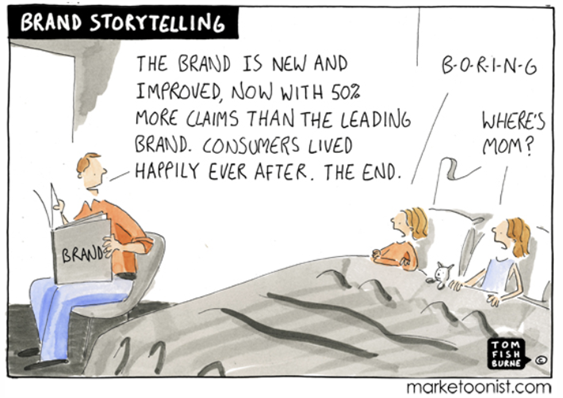
- Escaping reality: Story can’t replace substance. It works best when paired with data, evidence, or action. If it sounds like a brand campaign, people switch off. Aim to sound human, and humane.
For leaders and communications specialists, a simple way to start this week
And now, over to you. Is there one message your Management or C-suite team needs the organisation to remember? It’s time to put this into action and use story to make your message travel and stick.
Whether it is a priority shift, a new standard, or a revised customer commitment, replace your usual explanation with:
- One real example (a “proof” moment),
- One clear lesson, and
- One direct invitation: “what people should do next?”
If people repeat it afterwards, you’re on the right track. That’s the test: does your story travel?
Corporate storytelling is not “spin” with a friendly tone. It is a bridge between what leaders intend and what people hear.
Josephine reminds us that corporate storytelling is not about adding polish to leadership communication. It is about making strategy memorable, credible, and actionable. When organisations align their overarching narrative, leadership anchor stories, and everyday proof moments, communication begins to feel like direction rather than noise. In the end, the true test of a strong corporate story is simple: does it travel? If people repeat it, use it, and act on it, then the story is working.
*Source: Thomas Graeber, Christopher Roth, Florian Zimmermann, Stories, Statistics, and Memory, The Quarterly Journal of Economics, Volume 139, Issue 4, November 2024, Pages 2181–2225, https://doi.org/10.1093/qje/qjae020
Join Us Now!
Ready to elevate your marketing strategy? Be part of our Upcoming Events – where innovation, networking, and cutting-edge insights meet in vibrant cities around the world. We can’t wait to welcome you in person!
Can’t attend in person? No problem. Join BEETc On-Screen, our On-Demand Learning Platform, for exclusive access to 500+ sessions and over 300 hours of content from global summits. Upskill at your own pace, gain actionable insights, and stay ahead in a rapidly evolving business landscape.
Stay up to date with our In Person Summit, Session Information, and Agenda Updates by following us on:
See more MarTech Thoughts Content/ Interview pieces here!
Disclaimer: Views expressed in this article are solely those of the author and do not necessarily reflect the positions of any organisation, employer, publisher, or affiliated entity. Any references to products, services, or individuals are for informational purposes and do not constitute endorsement.
Last updated:March 2026