
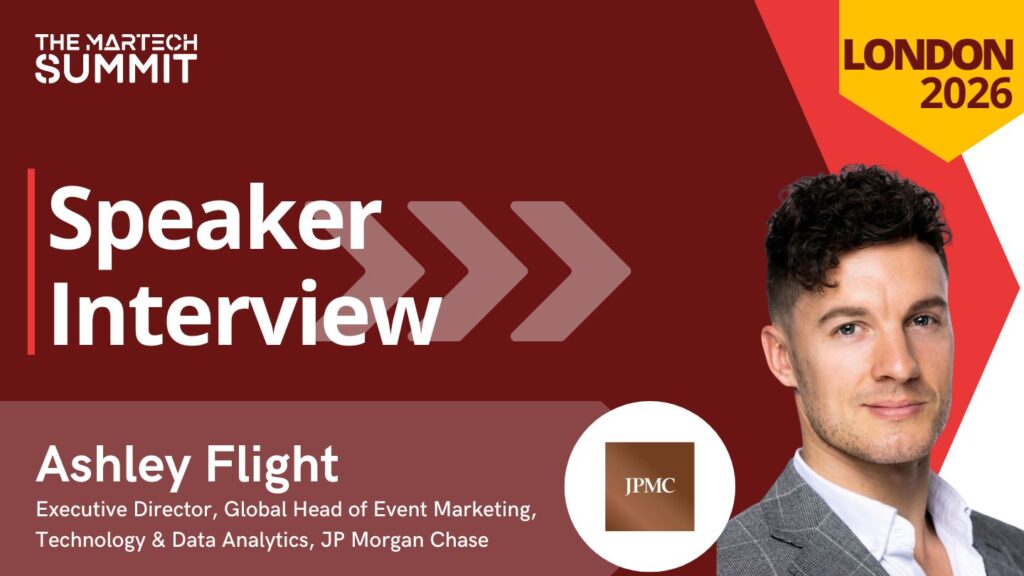
In financial services, marketing transformation is rarely just a technology challenge – it is also about navigating data, governance and complex organisational structures while still moving fast enough to create impact. Ahead of The MarTech Summit London, we spoke with Ashley Flight, Executive Director and Global Head of Event Marketing, Technology & Data Analytics at J.P. Morgan Chase. Drawing on more than 16 years of experience across marketing, analytics and technology, Ashley shares his perspective on overcoming transformation barriers, turning data into strategic decisions, and where AI could deliver the greatest efficiency gains for marketing teams.
About JPMorgan Chase
JPMorgan Chase is a global financial services firm providing banking, investment, payments and financial solutions to consumers, businesses, institutions and governments. Within its Commercial & Investment Bank, technology, data and analytics play an important role in supporting global client engagement and marketing activities. Ashley’s work focuses specifically on the evolution of event marketing technology, analytics and strategy, using data and MarTech to improve targeting, engagement, operational efficiency and ROI.
Quick Q&A with Ashley Flight
Could you please give us a quick introduction of yourself and share a bit about your role at JPMorgan Chase?
Nice to e-meet you, my name is Ash. I was born and raised in the lush green countryside of Devon, where my village had more sheep than people inhabiting it, before I moved to London in 2007. I’ve worked in marketing, data analytics and tech for over 16 years across a range of global financial services companies. In my current role, I oversee the delivery and transformation of our data analytics and event marketing technology for the events marketing team within the Commercial & Investment Bank at J.P. Morgan.
Why did you choose to participate in this summit?
I have attended this summit before, and it’s a fantastically organised event with great content, vendors and networking opportunities. I was excited at the prospect of joining a panel and sharing any insight that attendees might find useful, given I gained a lot of knowledge when I attended panel talks in previous years.
Having led digital transformation programmes across global financial institutions, what have you found to be the biggest challenge when introducing new technologies into established organisations?
Throughout my years working in large financial services organisations, the same challenge keeps coming up. Getting buy-in and approvals across all the different departments always takes longer than you’d expect, and that tends to hold back speed to market. Now that AI is baked into so many platforms and processes, it can add even more delays, simply because of the internal approvals needed to protect the firm.
As it stands, I don’t see this changing as these processes exist for good reason. But it’s one of the big reasons challenger banks can roll out features at a pace that’s still hard to match at larger, global institutions.
Throughout your career, you’ve worked with organisations that generate enormous amounts of data. Could you share a real example where data moved beyond reporting and directly influenced a strategic business decision or commercial outcome? What made it successful?
Throughout my career, I’ve worked with organisations generating enormous amounts of data, but the real value has always come from using it to shape decisions, not just report on them.
One example that stands out is when I leveraged complex data analytics to understand our customers’ behavioural habits. Rather than simply reporting on what customers were doing, I dug into the patterns behind their engagement to understand why. This allowed us to target them far more effectively, identifying what content resonated and creating detailed personas that gave us a clearer picture of who we were serving and how best to reach them.
What made it successful was that the data didn’t just sit in a dashboard. It directly influenced how we allocated marketing spend, refined our messaging and prioritised the channels that mattered most. The outcome was clear, stronger engagement, more efficient targeting, and a strategy genuinely rooted in customer insight rather than assumption.
AI is rapidly changing the marketing landscape. Where do you believe it will have the greatest impact over the next few years in your industry?
I predict the greatest efficiency gains will come in data farming and in the speed of summarising data and drafting summaries for leadership. While the technology still has some way to go, this is where it will have the biggest impact, improving the speed/accuracy of data analysis and ultimately, reshaping how we run events, marketing and brand campaigns with greater efficiency, engagement and ROI.
Can you share one personal or professional goal you’d like to achieve in 2026?
A personal goal: Being able to actually play a round of golf without losing half a pack of golf balls. I honestly am so terrible at this unforgiving sport.
Ashley’s experience highlights an important reality of marketing transformation: having the technology and data is only part of the equation. Creating meaningful impact also requires organisational buy-in, the ability to turn insights into decisions, and a clear understanding of where technology can genuinely improve efficiency.
From using data to challenge assumptions around client targeting to exploring AI for faster and more accurate analysis, his perspective shows how marketing teams can move beyond reporting and use data to influence real commercial outcomes.
Join us at The MarTech Summit London to hear more from Ashley and other marketing leaders navigating the next phase of MarTech, data and AI transformation.
The MarTech Summit London – Smarter Stacks. Stronger Growth.
The MarTech Summit London returns this November as Europe’s flagship MarTech event, bringing together over 600 senior marketing, customer experience, digital, data and technology leaders for two days of practical learning, meaningful networking and forward-looking discussions on the future of marketing technology.
Designed for practitioners rather than product pitches, this year’s summit features more than 70 speakers, 30+ leading solution providers, and over 33 sessions across three stages, covering everything from AI-powered marketing and customer intelligence to first-party data, marketing operations, customer experience and revenue growth.
Whether you’re modernising your MarTech stack, scaling AI adoption or improving marketing performance, The MarTech Summit London is designed to provide practical ideas you can take back to your organisation.
Hosted once again at Convene 155 Bishopsgate, this closed-door summit creates an environment where senior decision-makers can openly discuss challenges, exchange ideas, and learn from one another.
➡ Interested in becoming a partner? Don’t hesitate to get in touch with us at sponsor@themartechsummit.com.
Can’t attend in person? No problem. Join BEETc On-Screen, our On-Demand Learning Platform, for exclusive access to 500+ sessions and over 300 hours of content from global summits. Upskill at your own pace, gain actionable insights, and stay ahead in a rapidly evolving business landscape.
Stay up to date with our Speaker Line-up, Session Information, and Agenda Updates by following us on:
See more MarTech Thoughts interview pieces here!
Last updated: August 2026