
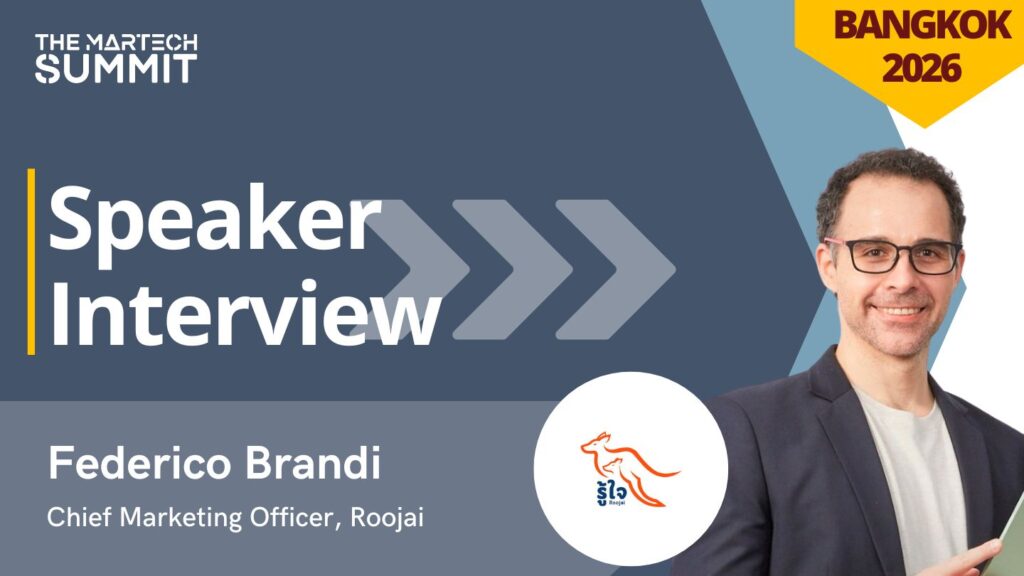
Customer acquisition may grab the headlines, but sustainable growth is often built on what happens after the first conversion. Ahead of The MarTech Summit Bangkok, we spoke with Federico Brandi, Group Chief Marketing Officer at Roojai, who will join the panel discussion “Prioritising Retention as the Growth Lever Most Brands Ignore.” Drawing on his experience across brand building, performance marketing, CRM and customer experience, Federico shares why retention deserves greater attention, how brand and performance work together to drive long-term value, and why AI could shift marketers from reacting to churn to predicting it before it happens.
About Roojai
Roojai is a digital insurance company using technology and data to make insurance more convenient and customer-focused. Operating with an online-first model, Roojai combines digital customer acquisition, CRM, marketing technology and data-driven customer experiences to support growth and long-term customer relationships. Its approach enables the business to connect performance marketing with brand building while using customer data to improve acquisition, engagement and retention.
Quick Q&A with Federico Brandi
Could you please give us a quick introduction of yourself and share a bit about your role at Roojai?
I’m Federico Brandi, Group Chief Marketing Officer at Roojai. I’ve spent most of my career at the intersection of brand building, digital growth, customer experience, and product innovation.
At Roojai, I lead marketing across our businesses, with responsibility for customer acquisition, brand strategy, CRM, partnerships, media, and marketing technology. My role is not only to drive growth but also to ensure that we build a trusted, scalable brand that can create long-term value for both customers and investors. As an online insurance company, we have the advantage of being highly data-driven, which allows us to combine strong performance marketing capabilities with meaningful brand-building initiatives.
Why did you choose to participate in this summit?
The Martech Summit brings together people who are shaping the future of marketing through technology, data, and innovation. Those are topics that are especially relevant for Roojai because our business was built on the idea that technology can fundamentally improve customer experience.
I also believe marketing is evolving faster than ever. AI, automation, privacy changes, and customer expectations are all reshaping the way we engage with customers. Events like this create valuable opportunities to exchange ideas, challenge assumptions, and learn from other practitioners facing similar challenges, and translate some winning ideas from different sectors to your own.
Throughout your career, you’ve balanced both brand building and performance marketing. How do you decide where to invest when both short-term growth and long-term brand value compete for budget?
I don’t see brand and performance as opposing forces. The most effective marketing organisations recognise that they work together.
Performance marketing captures existing demand. Brand marketing creates future demand.
When making investment decisions, I look at the marginal return of each channel. If performance channels are still delivering attractive returns, we continue to scale them. However, every performance channel eventually reaches a point of diminishing returns. That’s when stronger brand investment becomes essential because it reduces acquisition costs, improves conversion rates, and increases customer trust.
Research presented at executive marketing forums, including discussions I attended around Google Marketing Live, has consistently shown that companies maintaining a balanced approach between brand and performance tend to generate stronger long-term returns than those focused exclusively on either side.
At Roojai, we’ve seen the same dynamic. As brand awareness has grown, we’ve observed improvements in organic demand, conversion efficiency, better retention and customer trust. Our strategic planning therefore treats branding as a growth accelerator rather than an expense.
Many organisations still prioritise customer acquisition over retention. In your view, why does retention often receive less attention despite its impact on long-term growth?
Acquisition is easier to see and measure. New customers create an immediate sense of growth, while the value of retention compounds gradually over time.
The challenge is that retention doesn’t usually generate headlines inside an organisation. Yet financially, it’s one of the most powerful growth levers available. Every customer we retain reduces the amount of acquisition spending needed to maintain the same level of revenue.
In insurance, retention is particularly important because it creates a stable customer base that generates recurring premiums. That recurring revenue gives us greater freedom to invest in acquiring new customers, entering new segments, or launching new products.
The companies that achieve sustainable growth are typically those that look at the customer lifecycle as a whole rather than focusing solely on the first sale.
Looking ahead, what role do you think AI will play in customer retention, loyalty, and lifecycle marketing over the next few years?
I believe AI is fundamentally transforming marketing and customer experience.
First, we’ll see much greater personalisation. Instead of sending the same message to millions of customers, AI will help brands deliver individualised recommendations, coverage suggestions, and communication based on customer needs and behaviours. At a much faster pace than before since it will require a lot less manpower.
Second, automation will become significantly more sophisticated. Retention programs, renewal campaigns, and service journeys will increasingly be managed by AI systems that continuously optimise timing, messaging, and channels.
Third, creative production will accelerate dramatically. Marketers will be able to generate and test hundreds of creative variations simultaneously, allowing far more relevant customer communications. We are already seeing it at Roojai where our designers are able to produce new creative ideas at a much faster pace.
In insurance specifically, AI will improve self-service experiences through intelligent quotation systems, conversational assistants, and coverage optimisation tools that help customers find the right protection more easily.
I believe AI will allow organisations to shift from reactive retention to predictive retention. Meaning that instead of identifying customers after they’ve decided to leave, brands will be able to anticipate disengagement and intervene earlier with more relevant experiences.
Can you share one personal or professional goal you’d like to achieve in 2026?
One of my key goals for 2026 is to help build Roojai into one of the most recognised and trusted insurance brands in Southeast Asia.
Growth is important, but I believe the strongest companies are those that create lasting customer trust and become part of consumers’ consideration set long before they need to buy. Achieving that requires combining technology, customer experience, data, and strong brand building.
On a personal level, I also want to continue learning how AI can make marketing teams more effective, allowing marketers to spend less time on repetitive tasks and more time on strategy, creativity, and innovation.
Federico’s perspective makes a strong case for looking beyond the first sale and treating the entire customer lifecycle as a growth opportunity. For Roojai, retention not only creates recurring value but also gives the business greater freedom to invest in acquisition, new products and future growth. As AI enables increasingly personalised and predictive customer experiences, the opportunity is moving from simply responding to disengagement towards recognising it earlier and acting at the right moment.
Join us at The MarTech Summit Bangkok to hear more from Federico and fellow marketing leaders on building stronger customer relationships and turning retention into a sustainable growth engine.
The MarTech Summit Bangkok
The MarTech Summit Bangkok returns for its 5th edition in 2026, bringing together Thailand’s most senior marketing, digital, customer experience, and data leaders for a focused day of practical learning, meaningful networking, and peer-to-peer knowledge sharing.
As AI rapidly transforms how brands engage customers, measure performance, and build loyalty, marketing leaders face increasing pressure to deliver growth while navigating new technologies, changing customer expectations, and evolving privacy requirements.
The MarTech Summit Bangkok 2026 is designed to help marketing leaders move beyond the hype and focus on what truly matters: practical implementation, measurable business outcomes, and real-world experiences from brands already leading the way.
Hosted once again at the prestigious Hotel Nikko Bangkok, this closed-door summit creates an environment where senior decision-makers can openly discuss challenges, exchange ideas, and learn from one another.
➡ Interested in becoming a partner? Don’t hesitate to get in touch with us at sponsor@themartechsummit.com.
Can’t attend in person? No problem. Join BEETc On-Screen, our On-Demand Learning Platform, for exclusive access to 500+ sessions and over 300 hours of content from global summits. Upskill at your own pace, gain actionable insights, and stay ahead in a rapidly evolving business landscape.
Stay up to date with our Speaker Line-up, Session Information, and Agenda Updates by following us on:
See more MarTech Thoughts interview pieces here!
Last updated: August 2026