
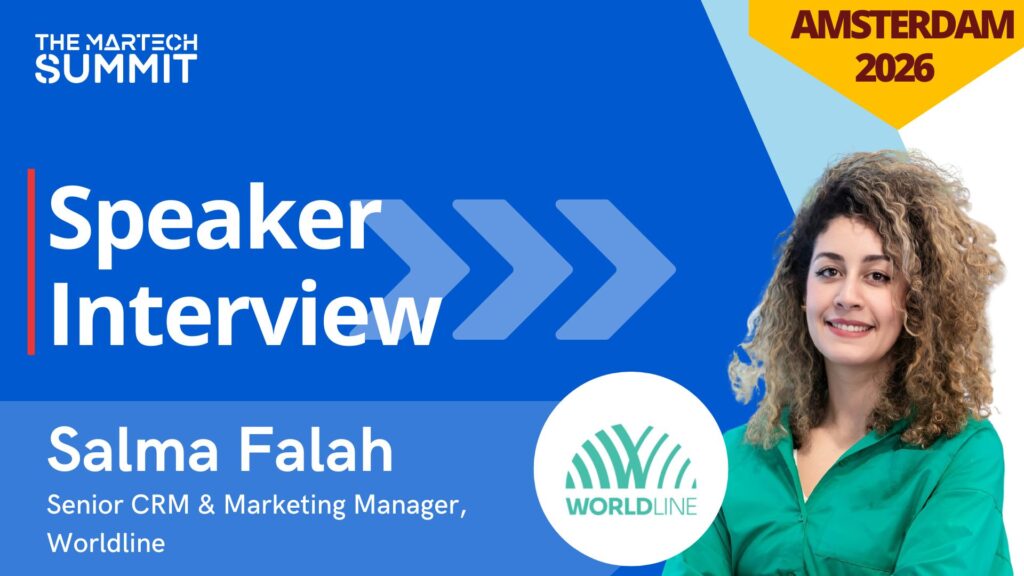
As B2B organisations face increasing pressure to prove marketing’s contribution to revenue, aligning demand generation, CRM, sales, and attribution has become more important than ever. At The MarTech Summit Amsterdam, we are delighted to welcome Salma Falah, Senior CRM & Marketing Manager at Worldline, to the Panel Discussion | [Growth, Performance & B2B Revenue Impact] Driving Efficiency Across the Funnel. With hands-on experience in demand generation, CRM governance, pipeline reporting, and sales alignment, Salma brings a practical perspective on how marketing teams can drive measurable business outcomes by building stronger connections between marketing activity and revenue performance.
About Worldline
Worldline is a global leader in payment services and transactional technology, helping businesses of all sizes manage payments, commerce, and customer interactions across digital and physical channels. Operating in more than 40 countries, Worldline provides secure payment processing, digital payment solutions, merchant services, and financial technology innovations that enable organisations to deliver seamless customer experiences. With a strong focus on innovation, trust, and digital transformation, Worldline supports businesses in accelerating growth and navigating the evolving payments landscape.
Quick Q&A with Salma Falah
Could you please give us a quick introduction of yourself and share a bit about your role at Worldline?
I’m a Senior CRM and Campaign Manager at Worldline’s Global Commerce division. I own demand generation, CRM governance, and pipeline reporting across Travel & Hospitality and Digital Business. Essentially, I sit between marketing and sales, making sure campaigns actually convert into pipeline, and that the handoff between the two teams works in practice, not just on paper.
Why did you choose to participate in this summit?
Because the gap between “we do revenue-led marketing” and actually doing it is still massive in most organisations. I wanted to be in a room having the honest version of that conversation, with practitioners who are dealing with the same CRM configurations, the same sales alignment challenges, and the same attribution headaches. Less theory, more of what actually works.
What is one workflow or automation process that has significantly improved team efficiency?
The biggest shift was introducing structure around the marketing-to-sales handoff. Not a new tool, just clearer rules for when a lead is genuinely ready to be worked, and automated alerts when leads go cold after handoff. It sounds simple, but it removed a huge amount of back-and-forth between teams and gave sales a reason to trust what marketing was sending them.
How do you use CRM and marketing automation to improve lead management and campaign performance?
The honest answer is that CRM and automation are only as good as the agreement between marketing and sales on what they’re measuring. I focus a lot on making sure both teams are looking at the same data, same definitions, same funnel stages, same pipeline view. When that alignment exists, the technology almost runs itself. When it doesn’t, no amount of automation fixes it.
Looking ahead, what excites you most about the future of CRM, automation, and revenue-led marketing?
The closing of the gap between intent and action. Right now, there’s still latency, a prospect does something meaningful, and it takes too long for the right person to respond. AI is starting to compress that. But what I’m most excited about is better attribution, moving away from single-touch models toward something that genuinely reflects how B2B buying decisions are made. When marketing can credibly show its contribution to pipeline across a multi-touchpoint journey, the whole conversation about marketing’s role in revenue changes.
Salma’s insights reinforce a simple but often overlooked truth: successful revenue marketing is not driven by technology alone, but by alignment. When marketing and sales share the same definitions, goals, and view of the customer journey, automation becomes more effective, attribution becomes more meaningful, and revenue growth becomes easier to achieve. As AI and advanced attribution models continue to evolve, her perspective offers valuable guidance for organisations looking to build more accountable, efficient, and revenue-focused marketing operations.
The MarTech Summit Amsterdam – Beyond the Buzz: Real Marketing, Real MarTech, Real Results
With a stronger foundation, a more refined agenda, and an emphasis on practical, high-impact insight, The MarTech Summit Amsterdam 2026 continues to evolve into a key meeting point for MarTech leaders across the region.
Join us on 25 June 2026 at Postillion Hotel and experience a day of unparalleled learning, networking, and growth at Postillion Hotel & Convention Centre Amsterdam, a modern and stylish venue in the vibrant eastern part of the city, perfectly suited for high-level discussions and networking.
➡ Interested in becoming a partner? Don’t hesitate to get in touch with us at sponsor@themartechsummit.com.
Can’t attend in person? No problem. Join BEETc On-Screen, our On-Demand Learning Platform, for exclusive access to 500+ sessions and over 300 hours of content from global summits. Upskill at your own pace, gain actionable insights, and stay ahead in a rapidly evolving business landscape.
Stay up to date with our Speaker Line-up, Session Information, and Agenda Updates by following us on:
See more MarTech Thoughts interview pieces here!
Last updated: June 2026